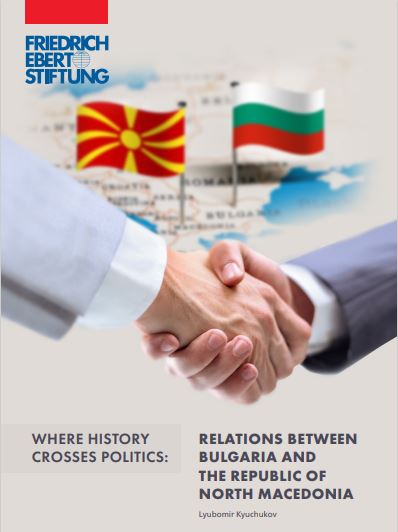
The two countries share a common history according to the 2017 bilateral Treaty of Friendship, Good-Neighbourliness, and Cooperation. This, however, turns out to be insufficient to unite policy and politicians.
Two political parties sharing the same name on both sides of the border are at the forefront of the dispute on the historical heritage.
Simplified to the utmost and rendered as practical as possible, the formula for exiting the impasse could be formulated thus: two neighbouring countries, both members of the EU, with a practically non-existent border between them, open to communion between citizens, businesses, and cultural institutions from both sides, where all disputes gradually grow ever less relevant, and where people do not confront each other.
***
In autumn 2019 Bulgaria marked a sharp turn in its approach to the Republic of North Macedonia (RSM) by making its support for the launch of negotiations for Albanian and RSM accession to the European Union contingent on a number of conditions. This in practice blocked both countries’ road to Europe, while adding a tough new issue to existing regional problems on the way to EU membership: the lack of progress in Serbian relations with Kosovo, the continual fragility of unitary statehood in Bosnia and Herzegovina, and more general difficulties on the part of local countries to fulfil criteria, largely as regards corruption and supremacy of the law.
The switch in Bulgaria’s position was in severe dissonance with the country’s hitherto unwavering support for the process of EU enlargement in the Western Balkans. Only eighteen months earlier the topic of the region’s European integration had been elevated to top priority in Bulgaria’s first EU Council presidency. At that time, the Sofia Declaration adopted by EU member states at Bulgaria’s initiative declared unanimous support for the European perspective of the Western Balkans and attempted to revive the Thessaloniki agenda[1] after a series of crises had gradually pushed enlargement significantly lower down the EU’s priorities.
What Bulgaria demanded, and from whom
The Bulgarian position was formalised in two documents: the government’s Framework Position of 9 October 2019[2] and the parliamentary Declaration[3] adopted with the support of all parliamentary parties the following day.
Most generally, Bulgaria withheld consent to set a date for the Intergovernmental Conference which would have launched accession negotiations before disputed bilateral issues with the Republic of North Macedonia had been resolved. Bulgaria insisted on EU monitoring of this process to be included in the negotiating framework, on good-neighbourliness to be affirmed as a horizontal criterion within the framework of the overall accession process, and on discharge of bilateral treaties with EU member states (Bulgaria and Greece) to be made an integral part of applicable conditions assessed within the framework of Chapter 35[4] in negotiations. This part of the Bulgarian position directs demands at Brussels rather than Skopje, meaning that Bulgaria is attempting to commit the European Union to its position.
The motives for the switch relate to“rewriting and appropriation after 1944 of the history of part of the Bulgarian people as one of the pillars of the anti-Bulgarian ideological construct of Yugoslav totalitarianism and the inadmissibility of any potential European legitimisation of this ideology of the past“[5]. As rendered into the thrust of concrete policy, the Bulgarian position includes a number of preliminary conditions, all of them now directed at Skopje. They include: efficient implementation of the 2017 Treaty of Friendship, Good-Neighbourliness, and Cooperation (the Good Neighbour Treaty); objective scientific interpretation of historical events as set out in historical sources; a renunciation of claims for the recognition of a Macedonian minority in Bulgaria; the rehabilitation of persons killed or subjected to repression for their Bulgarian national consciousness; adherence to the bilaterally agreed clause on the official tongue of the RSM; an affirmation that the shorthand name “North Macedonia“ refers solely to the political entity of the Republic of North Macedonia as opposed to the geographical region of Northern Macedonia; adapting school curricula so that they reflect history objectively; terminating “hate speech” towards Bulgaria; and removing North Macedonian signage and inscriptions which sow hatred towards Bulgaria and Bulgarians[6].
All these issues and tensions have been accumulating between the two countries for some decades, periodically visiting strains into bilateral relations. Bulgaria’s former approach drew a clear distinction between countering the doctrine of Macedonism that dominated Skopje policy and the striving not to antagonise the Macedonian public. By blocking EU accession negotiations, Bulgaria de facto renounced this twin-track approach for the first time since the close of the Second World War, attempting to internationalise disputes while relying on EU support as a member state.
The Treaty of Friendship, Good-Neighbourliness, and Cooperation
The treaty between Bulgaria and the then-Republic of Macedonia was signed in 1 August 2017. It builds on the 1999 Joint Declaration by the two countries’ prime ministers and forms the legal basis upon which bilateral relations are built.
Treaty signing was the result of sufficiently consistent Bulgarian policy towards its western neighbour over more than a quarter century, regardless of Sofia government changes. The policy bet on the positive development of bilateral relations, support for affirming the Republic of Macedonia’s newly acquired statehood, and the striving to discuss disputed issues in a constructive spirit. At least two significant facts stand out as markers of this period in Bulgarian policy. Bulgaria was first to recognise the new state’s independence on 15 January 1992, two months after its proclamation, moreover under its constitutional name of the Republic of Macedonia. Bulgaria backed the new country’s Euro-Atlantic integration. At Bulgarian initiative, the NATO 2008 Bucharest Summit Declaration, when the Alliance welcomed Albania and Croatia as members while Greece blocked the Republic of Macedonia’s candidacy, included a pledge that Macedonia would be invited immediately after the name dispute was resolved[7]. This in effect allowed the newly renamed Republic of North Macedonia to become NATO’s thirtieth member without having to traverse the complex candidate procedure anew.
Treaty signing was preceded by prolonged and difficult negotiations. For some years after Bulgaria produced the initial draft in late 2008, Nikola Gruevski’s nationalist Skopje government even refused to formally acknowledge its existence, let alone commit to negotiations. It was changes to the national and international political environment that created conditions for agreement. Several circumstances helped. The main one was the change of Skopje government, with Zoran Zaev’s new Social Democratic administration moving the issue of regulating relations with neighbours to the forefront. At the same time, the changing international environment and rising confrontation between global players seeking spheres of influence, including in the Western Balkans, prompted the USA and the EU to activate efforts at removing the barriers to RSM membership in NATO. In practice the Treaty between Bulgaria and the Republic of Macedonia delivered a powerful international stimulus in favour of resolving the name dispute between Skopje and Athens, the Prespa Agreement which set the new name of North Macedonia being signed in 2018.
The 2017 Treaty of Friendship, Good-Neighbourliness, and Cooperation between Bulgaria and the RSM did not resolve disputed issues. Still, contracting it provided the necessary legal basis for this. The Treaty converted the agreement in the two countries’ premiers’ 1999 Declaration into international legal duties (the formula regarding the Macedonian language and the de facto rejection of claims of a Macedonian minority in Bulgaria), amplifying them with several key aspects (foremost among them a definition of the concept of a common history and the establishment of a Joint Multidisciplinary Expert Commission on historical and educational issues)[8].
The Prespa Agreement augured mass protest in both Greece and North Macedonia, and the Treaty between Bulgaria and the Republic of North Macedonia likewise prompted critical reactions in both Bulgaria and the RSM. There is even the paradox that the Prespa Agreement enjoys much more respect in Bulgaria than in the two countries party to it. The reason for this is that it sets many concrete conditions before the Macedonian side, accompanied by a strict control mechanism, the like of which is absent from the Sofia-Skopje Treaty. It is for this reason that the main Bulgarian criticisms related to the Good Neighbour Treaty failing to commit the North Macedonian authorities to resolve a single concrete issue linked with the historic past. This sentiment hardened after the veto on RSM accession to the EU, the Treaty now seen not as a Bulgarian diplomatic success, but rather as weak and insufficient. Sentiment against it was even more critical in the RSM, where former premier Gruevski’s VMRO-DPMNE opposition party formally opposed its signing, while party leader Hristijan Mickoski called for its renunciation[9]. Even former president and former leader of the ruling Social Democratic Union of Macedonia Branko Crvenkovski declared that “the Treaty opens a Pandora’s Box in giving grounds for a series of Bulgarian demands which simply rule out any compromise“[10].
It ought to be made clear that any comparison between the treaties signed by Athens and Sofia with Skopje risks being both inopportune and inaccurate. The treaties are utterly different. Indeed, Bulgaria and Greece pursue entirely contrasting tasks through them: Greece proves that today’s Macedonian state has nothing to do with Greek history, while Bulgaria attempts to prove that everything had been common. The former case entails a single action, while the latter is part of a process: for Greece, the Prespa Agreement closes the matter, while for Bulgaria, the Treaty of Friendship, Good-Neighbourliness, and Cooperation opens the path to finding solutions. Moreover, in the international arena this Treaty is the sole instrument granting Bulgaria the right to insist on including bilateral issues into the EU accession negotiating framework, through the requirement for its implementation affixed into the negotiating framework.
History: the apple of contention
Then most significant breakthrough achieved in the Good Neighbour Treaty was the joint acceptance of the concept of a common history, and its placement in the preamble[11]. This intended to lay the basis for resolving all disputes on the topic. Yet it turned out that disagreement was immanent even within agreement. The Macedonian wording has the formula of zaednička istorijа[12], literally meaning shared rather than common history. Incidentally, in an interview subjected to fierce Skopje media criticism, premier Zaev stated “We don’t have a shared history, but rather a common history“[13].
Arguments about history have beset relations between Bulgaria and Yugoslavia (and the RSM since then) for over a century now. They relate to the policy, first by the Kingdom of Jugoslavia, and after the Second World War of the new Yugoslav federation led by Tito, to integrate the Macedonian area, change the ethnic character of its populace, and have its historical and cultural heritage meld into a separate identity. Put into other words, by erecting the political doctrine of Macedonism which proclaims the existence of a Macedonian nation from antiquity, through the Middle Ages to the present, and appropriating the histories of neighbouring countries. The Gruevski government demonstrated this policy at its most forthright: attempts to inject antiquity into Macedonian history by drafting Alexander of Macedon into the heritage of today’s RSM detracted from Greece, while attempts to co-opt as Macedonian the close of the First Bulgarian Kingdom during Samuil’s reign at the turn of the 10th and 11th Centuries detracted from Bulgaria.
This trend gathered pace after independence. It repays recall that the collapse of Yugoslavia and the distribution of the heritage of a common geographical, economic, political, and cultural entity objectively and inevitably entailed the emergence of submerged but long-held nationalist leanings. Nationalism turned into a most productive nation-building factor. Affirming their new statehoods, former Yugoslav republics (especially those which had never before enjoyed statehood, like Bosnia and Herzegovina, the Republic of North Macedonia, and also Kosovo) mandatorily underwent the formation of new state identities alongside national institutions and social consolidation. In other words, consolidating newly-acquired sovereignties inevitably entailed strengthened nationalistic processes that often led to problems with neighbours.
The Good Neighbour Treaty did not simply fix the concept of a common history, but also attempted to mark a practical step forward by imbuing it with concrete meaning. Another natural consequence of the Treaty was agreement to establish a Joint Multidisciplinary Expert Commission on Historical and Educational Issues and the intention to mark common historical events jointly (incidentally such events, including wreath-layings at the monuments of disputed historical figures, became rather frequent during the Noughties, only to come to a halt in more recent years)[14].
The establishment of the Joint Expert Commission on Historical and Educational Issues was a success for diplomacy and the striving for dialogue. It was a tool, and it ended up being used extremely badly. That being so, it was doomed to fail from the start. The blame for this was not in the Commission itself, but with the governments which burdened it with impossible tasks, transferring their own responsibilities onto it. It was loaded with the expectations of resolving all politically debatable issues (something outside its prerogatives), and of drawing up an inventory of historical personalities (something outside anyone’s ability, for the relevant list would never be finite). The Commission had no negotiated and approved remit, no bilaterally fixed agenda, no timeframe, and no clarity on how its deliberations would come to an end and how its potential areas of agreement would turn into binding commitments on the parties. In other words, it was an arena of talks, rather than negotiations. Ultimately, the Commission became a tribune for articulating differences, rather than a platform for attaining agreement.
Foremost, the Commission could not mark serious progress without achieving political consensus on the Treaty concept of a common history in terms of scope, content, and most of all timeframes. Only given this would any historical personality fall naturally into its relevant period. Logic and historical fact show that dividing ‘common history’ into two different lots does not stem from an individual action or fact, but is a complex process occupying sufficiently long periods[15]. Its beginning could fall right at Bulgarian Liberation in 1878 and the following year’s reversion of Macedonia to Ottoman rule following the Great Powers’ Berlin Congress, traverse Macedonian liberation and inclusion into the Kingdom of Jugoslavia after the 1912-1913 Balkan Wars and the First World War, and end with Macedonia’s transformation into an autonomous part of the Yugoslav federation after the Second World War.
Historical questions also have a direct bearing on the topic of modern Macedonian identity. The Skopje authorities, including President Pendarovski and premier Zaev, have repeatedly stressed that the issues of national identity and the Macedonian language are not subject to negotiation[16]. This is understandable inasmuch as it relates to affirming the country’s new identity. It ought to be noted, nevertheless, that Bulgaria has expressly declared its recognition of modern political realities and “does not dispute the citizens of North Macedonia’s right to self-determination and identity“[17]. The major problem here seems that both sides appear shy of an explicit articulation of the dynamics: from Bulgarian history to an independent present-day statehood for Macedonia. In this sense, perhaps the most synthesised resume of the dynamics between history and present as regards the problem of identity was given by the first Foreign Minister of the Republic of Macedonia and current adviser to President Pendarovski, prof Denko Maleski: “The entire objective truth must be told: that we were a single people, but are no longer that. We are now two different peoples with two different languages“[18].
A telling detail in the struggle for historical heritage between the two states is that the most implacable adversaries on the very forefront of the dispute are two very clearly defined nationalist parties, both bearing the same name VMRO: VMRO-DPMNE in the RS Macedonia and VMRO-BND in Bulgaria. Both contend to embody the heritage of the Internal Macedonian Revolutionary Organisation (the VMRO) established in the late 19th Century to liberate Macedonia after it was left within the Ottoman Empire. To a large extent the current dispute stems from the participation of each of these parties in the government of each country. It was between 2006 and 2016 that the Republic of Macedonia took a marked nationalist turn under premier Gruevski’s VMRO-DPMNE government, straining relations with neighbours, foremost among them Greece and Bulgaria. Participation by the VMRO-BND in premier Borissov’s coalition government, on the other hand, led to the sharp turn in Bulgarian policy towards the RSM.
The language issue
Bulgaria does not dispute “the right of the citizens of the Republic of North Macedonia to call their language as they wish“[19]. This is a declaration by the Bulgarian government. “The official language of the Republic of North Macedonia, in its origin and its structural and typological characteristics is a southwestern literary and regional norm of the Bulgarian language“[20]. This in turn is the major conclusion of a report prepared by the Bulgarian Academy of Sciences on the issue. These are the two theses forming the Bulgarian position on the language dispute between Sofia and Skopje. The two appear incompatible only at first. This is because they fail to take account of the development of the language since the First World War when the Kingdom of Jugoslavia took over what today is North Macedonia. Following both the logic of its own independent development, and that of the purposeful policy of the Belgrade authorities, this language has gradually drifted away from its roots and acquired certain indigenous features. Even former Republic of Macedonia premier Ljubčo Georgievski testifies to this by asking: “What is the problem in stating that during the times of the Ottoman Empire [i.e., until 1913] the official language used in all Macedonian organisations was Bulgarian?“[21] The concept of a Macedonian language was first floated in an August 1944 ruling by the Anti-Fascist Assembly for the National Liberation of Macedonia, additional letters being introduced into the alphabet and the language being codified subsequently. The ruling states that “The Macedonian state shall introduce the popular Macedonian tongue as its executive language“[22]. This was also in reaction to the fact that the Vardar Banovina (as the area was hitherto termed) had been handed over to administration by the Kingdom of Bulgaria after being occupied by Hitler’s Germany.
While recognising the RSM’s right to call its language as it wishes and taking account of the fact that individual countries’ languages are not subject to international recognition, Bulgaria also insists on EU documents referring to “the official language of the Republic of North Macedonia“ or, in extremis, to “the Macedonian language,“ with an asterisk and a footnote stating “According to the Constitution of the Republic of North Macedonia“[23]. This is the reason why the Skopje authorities also accepted the compromise formula in the Good Neighbour Treaty, viz. “Macedonian language according to the Constitution“[24]. In other words, the language question is resolved on the bilateral plane. The peculiarity in the Bulgarian position is that the requirement has already been directed at the EU. Here Bulgaria is running behind the train, having missed the opportunity of internationalising this bilateral agreement and place the issue before the UN (which has formally recognised the Macedonian language); the Macedonian interpreting booth at NATO headquarters in Brussels does not have asterisks and footnotes. This in turn leads the EU to demur. Despite this, the bilaterally accepted formula exists and injecting it as blanket wording into an EU document is a matter of political agreement and diplomatic skill on the part of interested parties.
Bulgaria not only recognised the newly independent state under its constitutional name of the Republic of Macedonia, but continued using it throughout the entire period leading up to resolution of the dispute with Greece in formal Bulgarian-Macedonian relations. It did not allow itself to become drawn into that dispute for an instant, while expressing concerns through diplomatic channels that some of the options under discussion for the new name (including “North Macedonia”) could prompt negative public reactions in Bulgaria[25].
Those concerns turned out to be justified. In more than a quarter century between the RSM’s independence proclamation and the Prespa Agreement, Bulgaria did not expressly require declarations to the effect that the name “Macedonia” related to the state rather than the geographical region. This related to the fact that the geographical extent of Macedonia is split between the three countries of Bulgaria, Greece, and the RSM. After 2018, however, speculation grew in Bulgaria that adding the adjective “North” to the name would give the Skopje authorities grounds for mounting territorial claims against Bulgaria, inasmuch as Pirin Macedonia, an area within Bulgaria, is also part of the northern half of the geographical area of Macedonia. The Gruevski government’s searches for the roots of the modern state in the region’s ancient and Mediaeval history at the expense of neighbouring lands strengthened these speculations.
This was also why Bulgaria insisted for the RSM to declare formally before the UN and all other international organisations that the short name of North Macedonia refers solely to the political entity of the Republic of North Macedonia, rather than to the geographical region of northern Macedonia (as formulated in the Explanatory Memorandum on the Republic of Bulgaria’s Relations with the Republic of North Macedonia in the Context of EU Enlargement and the Association and Stabilisation Process as leaked into the media)[26].
Turning this into a problem of bilateral relations is an element of the change in the Bulgarian approach after late 2019. In principle, this is an issue that is relatively easy to resolve since it calls merely for reaffirming the bilateral Good Neighbour Treaty’s Article 11.3 commitments which declare the absence of any mutual territorial claims[27]. Of course, it helps if both sides refrain from political provocations on the issue; subsequently, Bulgarian politicians contributed to escalating tensions. The Ministry of Foreign Affairs was even forced to disassociate itself from an election commercial by an MEP from the VMRO party, then part of the ruling coalition, which stated that “Macedonia is Bulgarian“[28].
The claims of a Macedonian minority in Bulgaria
“The Republic of Macedonia herby confirms that no part of its Constitution may or should be interpreted as offering, now or at any time in the future, any grounds for intervention into the internal affairs of the Republic of Bulgaria with the aim of defending the status and rights of persons who are not citizens of the Republic of Macedonia“[29]. This is the wording of Article 11.5 of the Good Neighbour Treaty. The passage is rather unusual for an international agreement because it imposes asymmetric responsibilities on one of the parties.
As with all other disputed issues, the reason for this is both in the historical context and in modern political realities. Scientific circles harbour sufficient evidence of the predominantly Bulgarian ethnic character of the Macedonian populace until the early 20th Century. It was after the inclusion of the area within the Kingdom of Jugoslavia that a process of “systemic de-Bulgarisation and years-long destruction of Bulgarian cultural and historical heritage in the country“[30] began. On the other hand, after the close of the Second World War and prior to the Paris peace accords, Bulgaria faced losing part of its landmass (Pirin Macedonia) to Yugoslavia as a consequence of its participation in the War on the side of the Hitlerite coalition and of the administrative rule by the Kingdom of Bulgaria over what today constitutes the RSM. To avoid such a turn of events and in concert with Moscow, the post-War Bulgarian government adopted the thesis of a new South Slav federation that would unite Bulgaria and Yugoslavia. The major unifying element in this would be the Macedonian populace. For that purpose Bulgaria began the process of forced formation of a Macedonian ethnicity within Pirin Macedonia which ended immediately after the breakdown in relations between Belgrade and Moscow in 1948. This, however, offered arguments to the RSM for keeping open the issue of a Macedonian minority in Bulgaria.
Taking account of the Good Neighbour Treaty, the Skopje authorities avoid formal tabling of the issue of Macedonian minority recognition in Bulgaria. At the same time, however, on the international level they sponsor the recognition of Macedonian ethnic parties and organisations in Bulgaria. In that manner they strive to show the problem not as one between Bulgaria and RSM, but one between Bulgaria and Bulgarians: between Bulgaria as a state and its citizens. Indeed, in a number of cases the European Court of Human Rights’s rulings do not favour Bulgaria. The reasons for this are not, however, because the Court insists on recognising a minority (something outside its ambit), but in the inept legal argumentations of Bulgarian courts in denying registration to relevant formations. This is also the motive used by Bulgaria to demand explicit repudiation of claims of a Macedonian minority by the RSM.
Meanwhile, after the April 2021 departure of Boyko Borissov’s government comprising the populist GERB (Citizens for the European Development of Bulgaria) and the nationalist VMRO, the Bulgarian position underwent a certain readjustment. President Rumen Radev attempted to realign the scope of the dispute from history to the defence of the rights of Bulgarian citizens and RSM citizens with Bulgarian consciousness. The idea was to make the Bulgarian position more comprehensible to EU partners and extricate Bulgaria from political isolation on the issue. As a consequence of this change, Bulgaria formulated a new demand: for the equality of Macedonian Bulgarians to be guaranteed through the Constitution and laws of the RSM“[31]. This in turn gave grounds to the Skopje opposition to pose the question of reciprocity by the RSM revising its commitments under the 2017 Good Neighbour Treaty by demanding the inclusion of a Macedonian minority in the Bulgarian Constitution[32].
It must be borne in mind that legal provisions on minorities on both sides of the border are entirely different. While Bulgaria stresses the equality of citizens’ rights and guarantees individual rights while bestowing no collective rights, the Constitution of the RSM regulates the defence of the collective rights of individual minorities (“parts of nations“). Further, the Preamble to the Constitution of the RSM explicitly names the seven peoples concerned: “the Macedonian people, part of the Albanian people, of the Turkish people, of the Vlach people, of the Serbian people, of the Romany people, and of the Bosniak people“[33]. The very absence of a Bulgarian people among these poses questions by itself. The fact is that both sides, each for its own reasons, refrained from taking steps to institutionalise such a minority. Skopje entertained serious concerns that adding Bulgarians to the Constitution would give impetus to increasing the number of citizens declaring Bulgarian ethnic roots, this eroding the basis of Macedonist ideology. Sofia, on the other hand, realised that instituting a Bulgarian minority would automatically lend support to the thesis of an historical autochthonous non-Bulgarian majority in Macedonia.
Tabling the issue of recognising Bulgarians as the eighth part-of-nation in the RSM Constitution, Bulgaria points to the circumstance that informal data show 120,000 North Macedonian citizens who also have Bulgarian passports[34] obtained after furnishing proof of Bulgarian ethnic origin. Their rights ought therefore to be protected on an equal basis with the foregoing peoples. Blocking the launch of the RSM’s EU accession negotiations, however, gave rise to very grave anti-Bulgarian sentiment in the RSM, including aggressive public reaction against citizens with Bulgarian self-consciousness. This gave grounds for the Skopje authorities to declare readiness to include Bulgarians in the Constitution[35], certain that under the prevailing circumstances the number of citizens who would readily proclaim their Bulgarian ethnic origins would be significantly lower than the number of those who possess Bulgarian passports.
Bulgaria falls into a trap of its own making
Bulgaria ushered itself into a trap. In its current position negatives stem from either continuing to block the negotiation process or even attaining compromise entail negatives. Even when, sooner or later, pressed by time or by partners, agreement is attained, the negatives would have largely done their job.
This is alreadyfelt as a sharp rise in anti-Bulgarian public sentiment in Bulgaria’s neighbour. Any public quarrel works in favour of Macedonism, by dividing and antagonising. Skopje often seeks to foment quarrels provocatively, yet the current one came as a gift from the Bulgarian side. Moreover, though Bulgaria’s declared aim was to fight Macedonism as an ideology of confrontation, its actual moves turned out to be entirely counterproductive: in practice, Bulgaria acted against its own interests. Blocking the launch of the RSM’s EU accession negotiations was a huge gift to Macedonism. Macedonism’s aim is to cultivate in Macedonian citizens (the term citizens is used advisedly here) a consciousness of identity that differs historically from that of Bulgarians and to make them believe they have nothing in common with Bulgaria. By blocking EU accession negotiations Bulgaria managed to achieve even more: for the RSM citizens to wish to have nothing to do with Bulgaria, even those of them cognisant of historical fact.
Immediately after the Bulgarian government adopted its Framework Position on EU Enlargement and the Process of Stabilising and Associating the RSM and Albania and after the Bulgarian parliament voted the related Declaration, opinion polls showed a sharp rise in RSM citizens who saw Bulgaria as an adversary: from under a percent after signing the 2017 Good Neighbour Treaty to over 20 percent in late 2019[36]. Subsequently this trend brought steady and widespread anti-Bulgarian public sentiment crystallising both into verbal aggressiveness against Bulgaria (escalating to the burning of a Bulgarian flag) and to threats against RSM citizens with Bulgarian ethnic consciousness (including turning the Bulgarian citizenship of Skopje’s newly-elected lady mayor into a propaganda mainstay against her election campaign).
Second, Bulgaria succeeded brilliantly in attaining international isolation for itself. The sad fact is that Bulgaria frittered away the entire set of benefits EU membership gave it. It failed in its attempt to use the EU as an instrument of collective pressure against the RSM. Moreover, as shown by the European Commission’s North Macedonia Report and adoption of the related European Parliament Resolution in March 2021, Bulgaria now faces not only Skopje, but also Brussels and the European institutions. The European Parliament resolution expressly states that abusing EU enlargement by member states wishing to resolve bilateral cultural and historic disputes threatens EU policy in the region, recapitulates that enlargement should rest on objective criteria and not be subject to hindrance by unilateral interests, congratulates the RSM for its efforts to resolve bilateral issues with neighbours, and directs a general call for the earliest possible start of negotiations with the RSM and Albania[37].
The EU does not understand and does not accept the Bulgarian position, and this is not a problem for the EU, but for Bulgaria. At the same time, Bulgaria has taken all the negatives, both from the EU and from the region, for blocking enlargement. Moreover, those member states which hope to see enlargement hampered by all available means, and which have for years blocked EU enlargement[38], happily take cover behind Bulgaria’s back. This includes those who oppose the launch of negotiations with Albania and those who want Albania separated from North Macedonia. This in turn made Bulgaria guilty not only before the RSM, but also before Albania. On the other hand, the negotiations framework and the new negotiating mechanism are so designed that all of Eastern Europe would still be negotiating if its accession had followed the new rules. Yet, it is Bulgaria who has now assumed the responsibility for all delays and hindrances lying in wait in this negotiating framework. Worse, Bulgaria squandered all positives it had accumulated from its own EU Council presidency priority of Western Balkan accession. This has created negative sentiment not only in the Republic of North Macedonia, but also in Albania, as well as other neighbouring countries, while opening wide the door for external influence in Skopje, including from neighbours of North Macedonia.
A third aspect can be added to the above: nationalist discourse has become normalised in Bulgarian politics, launching a patriotic race to the bottom that paints all critics as traitors. The accent there is more on accumulating domestic political dividends than solving any foreign policy task.
The road ahead?
Clearly, the crisis in relations between the two countries can only be overcome through negotiation and the adoption of a bilaterally acceptable solution. Two areas for action may be defined here.
First and foremost, bilateral dialogue, without which no resolution would be possible. The first and mandatory condition for this is for mutually confrontational speech to cease, especially on the part of politically responsible factors, for hate speech to be condemned, and for shared confidence to be restored. The environment for this has worsened considerably over the past two years and offers no grounds for expecting any rapid breakthrough. One proof is the virtual halt in the deliberations of the Joint Commission on Historical Issues. This unambiguously transfers the negotiating process at the political and inter-state level into the framework of the Joint Intergovernmental Commission established under the Good Neighbour Treaty, or else into some other talks format which is yet to be specially agreed. Any negotiations ought to have sufficiently clear timeframes and to conclude with legally binding pledges.
The other area for action falls within the ambit of the EU. If Bulgaria wishes to enjoy support there (instead of complaining that all other member states and Union bodies are backing the candidate RSM at the expense of member state Bulgaria), it should begin formulating arguments that are understandable and acceptable to the EU. Bulgaria most successfully managed to extricate the Republic of North Macedonia from the duty of having to meet the criteria – a duty which would have burdened it throughout accession negotiations for each Chapter – while at the same time focusing the entirety of international pressure upon itself.
Contrary to the widespread opinion that Bulgaria need not rush for any reason and can afford to wait while Skopje concedes to all Bulgarian conditions, analysis rather points to the opposite: the time factor does not favour the Bulgarian interest. The number of RSM citizens who reject the Bulgarian position does not diminish with every passing day, but rather grows. Meanwhile, growing acuteness in the global confrontation with Russia and China and the thrust to halt their advance in the region would lead to constantly growing international pressure to unblock the process of Western Balkan EU accession, and this pressure would be keener on Sofia than on Skopje. Daubing the entire region with the impression of heightened political insecurity and destabilisation risk would inevitably impact Bulgaria negatively, as a political burden and in terms of economic development and attracting investment. Meanwhile, the escalation of anti-Bulgarian sentiment in the RSM would engender a much greater public resistance against possible reasonable compromises. The same relates to chauvinist sentiment in Bulgaria that would render the job harder for any Bulgarian government setting itself the aim of finding a mutually acceptable solution to the problems. That is why it is in Bulgaria’s interest to be the active party in overcoming the block. Sooner or later an agreement to this end will be reached. Yet in public circles and individual minds relations will no longer be defined by the common heritage but by the accumulated difference.
Ultimately all comes down to what Bulgaria’s strategic aim is with regard to the Republic of North Macedonia. A formula simplified to the utmost and lowered to the pragmatic floor could be formulated thus: two neighbouring EU member states with a practically nonexistent border between them and open to communion at the level of individuals, businesses, and cultural events from both sides, where all these arguments grow ever more irrelevant and most importantly, where people no longer confront each other. Put another way, Bulgaria ought to think of Macedonia as something close, as people, and in the future tense, rather than as something foreign, as territory, and with a gaze fixed at the past.
***
Lyubomir Kyuchukov is a career diplomat. He has a doctorate in political science and has sat on the Council of Ministers’ European Integration Council and the Bulgarian President’s European and Euro-Atlantic Integration Council. Between 2005 and 2009 he served as Deputy Minister of Foreign Affairs, and between 2009 and 2012 as Bulgarian Ambassador to London. He is currently Director of the Economics and International Relations Institute, Chair of the Mezhdunarodni Otnoshenia journal’s Editorial Board, and sits on the Editorial Board of the Sofia University of the National and World Economy’s Bulgarian Journal of International Economics and Politics.
[1] Sofia declaration of the EU-Western Balkans summit, 17 May 2018. Accessed at: https://www.consilium.europa.eu/media/34776/sofia-declaration_en.pdf (20.05.2018).
[2] Рамкова позиция относно разширяване на ЕС и процеса на стабилизиране и асоцииране: Република Северна Македония и Албания. 9 октомври 2019 г. [Framework Position on EU Enlargement and the Stabilisation and Association Process: the Republic of North Macedonia and Albania] Accessed at: https://www.gov.bg/bg/prestsentar/novini/ramkova-pozitsia (12.11.2019).
[3] Декларация на Четиридесет и четвъртото Народно събрание на Република България във връзка с разширяването на Европейския съюз и процеса на стабилизиране и асоцииране на Република Северна Македония и Република Албания. 10 октомври 2019 г. [A Declaration by the Republic of Bulgaria Forty-Fourth National Assembly in Connection with EU Enlargement and the Stabilisation and Association Process for the Republic of North Macedonia and the Republic of Albania] Accessed at: https://www.gov.bg/bg/prestsentar/novini/ramkova-pozitsia (12.11.2019).
[4] Framework Position, op. cit.
[5] Ibid.
[6] Declaration, op. cit.
[7] Bucharest Summit Declaration. Issued by the Heads of State and Government participating in the meeting of the North Atlantic Council in Bucharest on 3 April 2008. Accessed at: https://www.nato.int/cps/en/natolive/official_texts_8443.htm (18.11.2015).
[8] Договор за приятелство, добросъседство и сътрудничество между Република България и Република Македония. Държавен вестник, бр. 19 от 02.03.2018 г., стр. 16. [Treaty of Friendship, Good-Neighbourliness, and Cooperation between the Republic of Bulgaria and the Republic of Macedonia, the Darzhaven Vestnik state gazette, issue 19 of 02.03.2018, p 16] Accessed at: https://dv.parliament.bg/DVWeb/showMaterialDV.jsp?idMat=123506 (26.09.2018).
[9] Мицкоски зове РСМ да прекрати едностранно договора с България. [“Mickoski calls for the RSM to renounce the treaty with Bulgaria unilaterally”] Accessed at: https://news.bg/politics/mitskoski-zove-rsm-da-prekrati-ednostranno-dogovora-s-balgariya.html (20.05.2021).
[10] Бранко Цървенковски: Договорът с България отвори кутията на Пандора. Труд онлайн, 27.09.2021. [“Branko Crvenkovski: the treaty with Bulgaria opens Pandora’s Box”] Accessed at: https://trud.bg/бранко-цървенковски-договорът-с-българия-отвори-кутията-на-пандора/ (27.09.2021).
[11] Treaty, op. cit., p. 16. Accessed at: https://dv.parliament.bg/DVWeb/showMaterialDV.jsp?idMat=123506 (26.09.2018).
[12] Договор за за пријателство, добрососедство и соработка меѓу Република Македонија и Република Бугарија. [Treaty of Friendship, Good-Neighbourliness, and Cooperation between the Republic of Macedonia and the Republic of Bulgaria] Accessed at: https://vlada.mk/sites/default/files/dogovori/Dogovor_Za_Prijatelstvo_Dobrososedstvo_Sorabotka_Megju_Republika_Makedonija_I_Republika_Bugarija.pdf (15.10.2020).
[13] Заев: Договорът ще бъде закон, ще преследвам омразата, „Дълбоката държава“ е в опозицията. Агенция БГНЕС, 25.11.2020. [“Zaev: the treaty will be law; I shall prosecute hatred. The Deep State is in the opposition. The BGNES Agency] Accessed at: https://bgnes.bg/news/zaev-dogovorat-shte-bade-zakon-shte-presle/ (03.11.2021).
[14] Treaty, op. cit, p 16.
[15] Георги Първанов: България и Македония трябва да се договорят, че обща ни история има своите корени в Средновековието, развива се през Възраждането до първите десетилетия на 20 век. Агенция „Фокус“, 01.10.2019. [“Georgi Parvanov: Bulgaria and Macedonia must agree that our common history has its roots in the Middle Ages and develops through the Revival Period and into the initial decades of the 20th Century”, The Focus Agency] Accessed at: http://focus-news.net/opinion/2019/10/01/51305/georgi-parvanov-balgariya-i-makedoniya-tryabva-da-se-dogovoryat-che-obshta-ni-istoriya-ima-svoite-koreni-v-srednovekovieto-razviva-se-prez-vazrazhdaneto-do-parvite-desetiletiya-na-20-vek.html (02.10.2019).
[16] Северна Македония не ѝ трябва ЕС, ако ще се отказва от език и идентичност [“North Macedonia does not need the EU if it intends to repudiate language and identity”]. Accessed at: https://news.bg/politics/severna-makedoniya-ne-y-tryabva-es-ako-shte-se-otkazva-ot-ezik-i-identichnost.html (02.05.2020).
[17] Време е правителството на Република Северна Македония да се откаже от манипулативната теза, че България оспорва правото на самоопределение и идентичността на гражданите на Република Северна Македония или правото им да наричат езика си както пожелаят. 09 декември 2020. [“It is time for the Republic of North Macedonia government to renounce the manipulative thesis that Bulgaria disputes the right to self-determination and identity of the citizens of the Republic of North Macedonia or their right to call their language as they wish. 09 December 2020”] Accessed at: https://mfa.bg/bg/news/27296 (09.12.2020).
[18] Има ли решение за историческите въпроси между София и Скопие? ТВ Европа, 28.04.2020. [“Is there a solution to the history dispute between Sofia and Skopje?” ; TV Evropa, in Bulgarian] Accessed at: https://www.tvevropa.com/2020/04/ima-li-reshenie-za-istoricheskite-vaprosi-mezhdu-sofiya-i-skopie/ (10.11.2021). Што точно рече Денко Малески за бугарската ТВ Европа?. 360 степени, 29.04.2020. [“What precisely did Denko Maleski say before the Bulgarian TV Evropa?” 360 Stepeni] Accessed at: https://360stepeni.mk/shto-tochno-reche-denko-maleski-za-bugarskata-tv-evropa-video/ (10.11.2021).
[19] “It is time” op. cit.
[20] За официалния език на Република Северна Македония. Издателство на БАН „Проф. Марин Дринов“, С. 2020, стр. 7. [“On the official language of the Republic of North Macedonia”, p 7, The Bulgarian Academy of Sciences Prof Marin Drinov Publishers, Sofia, 2020]
[21] Любчо Георгиевски: Гоце Делчев е пишел на български, но никъде в Македония не се говори за това. Медиапул, 08.092021. [“Ljubčo Georgievski: Goce Delčev wrote in Bulgarian but nowhere in Macedonia is this acknowledged”, Mediapool] Accessed at: https://www.mediapool.bg/lyubcho-georgievski-vsichki-dokumenti-na-vmro-sa-napisani-na-balgarski-news319121.html (08.03.2021)
[22] Служебен вестник на федералната единица Македониjа во демократска и федеративна Jугославиjа, година 1, броj 1, стр. 3, Скопjе. [“The Executive Gazette of the Federal Unit of Macedonia within Democratic and Federal Yugoslavia”, Year 1, issue 1, p 3, Skopje] Accessed at: http://www.slvesnik.com.mk/Issues/0B06AFA2DCBB4B42B443C52DC94D844E.pdf (20.10.2021)
[23] Разяснителен меморандум относно отношенията на Република България с Република Северна Македония в контекста на разширяването на ЕС и на процеса на асоцииране и стабилизиране. [Explanatory Memorandum on the relationship of the Republic of Bulgaria with the Republic of North Macedonia in the context of EU enlargement and the association and stabilization process] Accessed at: https://www.actualno.com/politics/ekskluzivno-kakvo-pishe-v-memoranduma-na-bylgarija-za-severna-makedonija-news_1500405.html (17 .09.2020).
[24] Treaty, op. cit.
[25] Bulgaria: DVC With MFA, Shared Views On Kosovo. 2008 October 16, 14:48 (Thursday). 08SOFIA663_a. Available from: https://wikileaks.org/plusd/cables/08SOFIA663_a.html (02.10.2014).
[26] Разяснителен меморандум относно отношенията на Република България с Република Северна Македония в контекста на разширяването на ЕС и на процеса на асоцииране и стабилизиране. [Explanatory Memorandum on the relationship of the Republic of Bulgaria with the Republic of North Macedonia in the context of EU enlargement and the association and stabilization process] Accessed at: https://www.actualno.com/politics/ekskluzivno-kakvo-pishe-v-memoranduma-na-bylgarija-za-severna-makedonija-news_1500405.html (17.09.2020).
[27] Treaty, op. cit.
[28] Скопие с протестна нота срещу провокация на Джамбазки. Медиапоол, 30.03.2021. [“Skopje sends protest note at Dzhambazki provocation”, Mediapool] Accessed at: https://www.mediapool.bg/skopie-s-protestna-nota-sreshtu-provokatsiya-na-dzhambazki-obnovena-news319995.html (30.03.2021).
[29] Ibid.
[30] Президентът Румен Радев в Словения: Системната дебългаризация и унищожаването на българското културно-историческо наследство в Република Северна Македония не е двустранен, а европейски проблем. БТА, 06.10.2021. [“President Rumen Radev in Slovenia: Systemic de-Bulgarisation and the destruction of the Bulgarian cultural and historical heritage in the Republic of North Macedonia is not a bilateral, but a European problem”, BTA] Accessed at: http://www.bta.bg/bg/video/show/id/0_uk4o7cyk (07.10.2021).
[31] Румен Радев: Македонските българи, тяхното равноправие в политическия, обществения, културен и икономически живот на РС Македония и стриктното изпълнение на Договора от 2017 г. са ключът към вратата на ЕС. 27.10.2021. [“Rumen Radev: The Macedonian Bulgarians, their equality in the political, public, artistic, and economic life of the RSM, alongside strict implementation of the 2017 Treaty are the key to the EU’s door”] Accessed at: https://m.president.bg/bg/news6263/rumen-radev-makedonskite-balgari-tyahnoto-ravnopravie-v-politicheskiya-obshtestveniya-kulturen-i-ikonomicheski-zhivot-na-rs-makedoniya-i-striktnoto-izpalnenie-na-dogovora-ot-2017-g-sa-klyuchat-kam-vratata-na-es.html (28.10.2021).
[32] Мицкоски: Ако Бугарите влезат во Уставот, тогаш треба и Македонците во Бугарија да бидат дел од бугарскиот Устав. 06.10.2021. [“Mickoski: If the Bulgarians enter the Constitution, then Macedonians in Bulgaria should form part of the Bulgarian Constitution” Accessed at: https://republika.mk/vesti/mickoski-ako-bugarite-vlezat-vo-ustavot-togash-treba-i-makedoncite-vo-bugarija-da-bidat-del-od-bugarskiot-ustav/ (06.10.2021).
[33] Устав на Република Северна Македониjа. [Constitution of the Republic of North Macedonia] Accessed at: https://www.sobranie.mk/content/Odluki%20USTAV/UstavSRSM.pdf (20.11.2021).
[34] Каракачанов в Македония: Процедурата по издаване на български паспорти трябва да се улесни. [“Karakachanov: the procedure for issuing Bulgarian passports must be made easier”] Accessed at: https://novini.bg/bylgariya/politika/456332?comment=like&page=1 (23.11.2017).
[35] Заев: Пред влезот во ЕУ ќе го отвориме Уставот да го впишеме и бугарскиот народ. [“Zaev: Before EU accession, we shall open the Constitution and enter the Bulgarian nation”] Accessed at: https://www.slobodnaevropa.mk/a/31312922.html (17.06.2021).
[36] MakPress: Негативното отношение към България в Македония за една година се е увеличило с 23%. [“MakPress: Negative sentiment towards Bulgaria in Macedonia grows 23 percent in a year”] Accessed at: https://www.dnes.bg/balkani/2019/10/16/za-vse-poveche-makedonci-bylgariia-e-nepriiatelska-strana.426359,2 (16.10.2019).
[37] Motion for a European Parliament Resolution on the 2019-2020 Commission Reports on North Macedonia. (2019/2174(INI). Accessed at: https://www.europarl.europa.eu/doceo/document/A-9-2021-0040_EN.html (10.03.2021).
[38] Брюксел каза на Тирана и Скопие да чакат за еврочелнството. [“Brussels tells Tirana and Skopje to wait for European membership”] Accessed at: https://news.bg/world/bryuksel-kaza-na-tirana-i-skopie-da-chakat-za-evrochlenstvoto.html (12.06.2019).