A piece of history for introduction
On January 9, 1853 – five months before the start of the Crimean War, Grand Duchess Elena Pavlovna was hosting a dinner for the diplomatic corps in St. Petersburg. During the conversation with the British Ambassador Hamilton Seymour Emperor Nicholas I picked his favorite theme of the „sick man of Europe – Turkey“.
The Emperor said „I would like to talk to you as a gentleman to gentleman. If we manage to reach an agreement between me and England, then it would be indifferent to what the rest are doing or will do. So, frankly speaking, I straightforwardly declare to you that if England intends in the near future to conquer Constantinople, then I will not allow it to happen. I do not impose on you such intentions, but in such cases it is preferable to speak clearly. In turn I am willing as well to assume the obligation not to stay there as an owner. Of course the staying there in the quality of a guardian is something else. It may happen so that circumstances would compel me to enter Constantinople, if something unforeseen turns out. But neither the Russians nor the British nor the French should conquer Constantinople. And just for that reason Greece will not get it. I will never let this happen. „
Further the Emperor continued the conversation in the following manner: „Let Moldavia, Wallachia, Serbia and Bulgaria be given under the protectorate of Russia. As for Egypt, I fully understand the importance of this territory for England. Therefore, I can only say that if during the distribution of the Ottoman legacy after the collapse of the empire, you master Egypt, I will not object. The same will go for Candia – (so then was the name of the Crete island). This island might suit you and I do not see why it can not become a British possession. „End quote.
Over the next two weeks Nikolas I and ambassador Seymour held three more talks, further developing the Emperor’s proposal for the dissection of the Ottoman Empire, without prejudging the fate of Arabia, Mesopotamia and Asia Minor.
The Emperor made three grave errors. First, considering that France is weak after the unrest in the late 40s and that the new Emperor Napoleon III will not risk being dragged into distant war, Nicolas I ignored France in his accounts. Second, he believed that Austria-Hungary can not counteract and third, he overestimated his personal friendly relations with Queen Victoria misjudging the English constitutional theory and practice.
One year after the first conversation between Nicholas and Seymour, the combined Anglo-French fleet entered the Black Sea and the two admirals who commanded it announced to the Russian authorities that they have the task of guarding the Turkish ships and ports from Russian attacks.
The similarities of these events with some contemporary episodes from the past two years can hardly give us a clue about what kind of conversations where and for what are taking place nowadays by the great powers, such as the one several-hours long meeting in Sochi between Lavrov and Kerry last year, just two days before the NATO summit in Antalya.
Black Sea and geopolitics
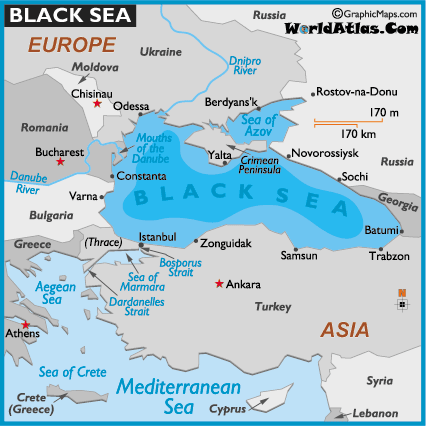
In that distant 1853 the Black Sea for the first time became the center of political maneuvering and diplomatic moves of the most important of that period geopolitical players. Being an internal Turkish lake till the late 18th century, the Black Sea and its adjacent areas gradually became one of the most important geopolitical regions in the world. The reason for this is its organic link with the eastern Mediterranean, and this connection is the starting point for control over vast areas of three continents. Situated between Europe, Asia and the Middle East, this crossroads of different cultures and civilizations concentrates in itself some of the most acute problems of modern „world order“. This is duе to its being the intersection from one side of the national interests of the leading regional countries – Russia and Turkey, and from another – of the geopolitical and geo-economic interests of the world’s major players – the US, EU and China.
The attention to the Black Sea region is mainly due to its transit importance. And it manifests itself in its military-political dimension – access of Russia to „warm seas“ and the entrance to the „soft parts of Russia“ by its potential adversaries, as well as in the economic importance of passing through it of important highways joining the West with hydrocarbons rich areas of Central Asia, the Middle East and the Caucasus. The problems of pipelines in the Black Sea areal are a case for a separate and very long lecture. Here, however, I would like to note that on the one hand the prospects of promising new pipeline projects are grounds to forecast an increase in the role of the Black Sea region into the world economy and geopolitics, but on the other the area is developing as one of the points with a potentially high genesis for conflicts.
A little bit of the theory of conflicts and conflict management
Crisis and conflict
- The conflict is a manifestation of a crisis in the system.
- In a crisis the system leaves the established equilibrium going through a period of disarray and is rearranged into a new equilibrium point.
- Conflict is disruptive exit from the crisis – the system is reorganized at a lower level of functioning.
Genesis and deployment of conflict
- intercommunal conflicts tend to escalate (shizmogenezis).
- Shizmogenezis can be symmetrical and asymmetrical.
- In the first case conflictive behavior grows symmetrically for both parties involved (Israeli-Palestinian relations).
- In the second case the more peaceful stands one side, the more aggressive is the standing of the other (relations between Nazis and Jews).
Genesis of ethnic conflicts
- The overlap between social and/or political inequalities of ethnic division is a generator of a sectarian conflict.
- excluded groups consider their situation as unfair and seek to change it by different means.
- This change can be done by way of incorporation (if the dominant group is responsive) or on the path of conflict.
Ethnicisation of a conflict
- Economic and power conflicts often are ethnisized afterwards.
- In this process, the pursuit of particular interests of individuals and organizations is presented as a defense of community identity and as a struggle for affirmation of values.
- As a rule the most interested in exacerbating latent ethnic conflicts are candidates for leaders in communities.
Perpetuation of the conflict
The conflict is perpetuated
- when its support turns into a matter of identity for a significant part of the community members.
- when it is integrated into the culture and plays in the emotional life of the community: Palestine and Israel.
- when it becomes an explanatory model for social phenomena of individual, family and community level.
- Frozen conflicts – these are conflicts that are temporarily suppressed by means of power, but have not found a satisfactory solution and can easily ignite.
Conflict management
- Technology for conflict management: early warning, prevention, mediation arbitration.
- A key condition for successful mediation is the willingness of both sides to participate in the process.
- The assigned mediator must be neutral third party whose authority is recognized by both sides in the conflict.
- legitimate representatives of communities are needed to receive a mandate to negotiate with the participation of the intermediary.
- Getting the representatives out of confilct zone and ensuring conditions for negotiation.
- Redefining the conflict from the language of values in the language of interests.
- Formation of a reference group and building a culture of negotiation.
- Reaching a mutually acceptable compromise.
- Engaging communities with the agreements reached.
- Permanent care to preserve the legitimacy of negotiators to their communities.
Conflict and Politics
- Political leadership plays a key role in the origin, development and resolving intercommunal conflicts.
- Leadership could push the conflict to resolve it or to radicalize it.
- Often exacerbation of the conflict is the result of the struggle for leadership within the community.
- The political abuse of ethnic conflicts is typical for underdeveloped and divided societies with weak civic culture and democratic tradition.
So the short definition of a frozen conflict in international relations is a situation in which active armed conflict has been brought to an end, but no peace treaty or other political framework resolves the conflict to the satisfaction of the combatants. Therefore, legally the conflict can start again at any moment, creating an environment of insecurity and instability.
The term has been commonly used for post-Soviet conflicts, but it has also often been applied to other perennial territorial disputes. The de facto situation that emerges may match the de jure position asserted by one party to the conflict; for example, Russia claims and effectively controls Crimea following the 2014 Crimean crisis despite Ukraine’s continuing claim to the region. Alternatively, the de facto situation may not match either side’s official claim. Thedivision of Korea is an example of the latter situation: both the Republic of Korea and the Democratic People’s Republic of Korea officially assert claims to the entire peninsula; however, there exists a well-defined border between the two countries’ areas of control.
Frozen conflicts sometimes result in partially recognized states. For example, the Republic of South Ossetia, a product of the frozen Georgian–Ossetian conflict, is recognized by only seven states, three of which are partially recognized states themselves.
Comparison between Balkan frozen conflicts and those around the Black sea
With this theoretical background we can try to concentrate on the problems of the regional frozen conflicts. The most obvious conclusion is that the various existing regional structures have not developed abilities to tackle local conflicts and ensure the safe development of the area.
Experience in the Balkans in the settlement of ethno-political conflicts highlights several common traits.
First, the interference of supranational structures begins in the phase of the „hot conflict“ and usually it takes the side of the losers at that moment.
Secondly, the resolution of the conflict at international level through the United Nations and the EU, is preceded either by implementation of large-scale military intervention of NATO (Bosnia and Herzegovina, Kosovo) or by direct political intervention of the alliance in the conflict areas (RMacedonia).
Thirdly, the documents regulating the relations between the parties to the conflict are being developed by international mediators, not by the participants in the conflict.
On the fourth place, the proposed models do not take into equal account the interests of participants in the conflict, paving and protecting only the positions of those who (for some reason) are patronized by the West.
Fifth, the implementation of proposed models requires constant international military and political presence and strict control, which is enshrined in the relevant documents from supranational structures.
Ultimately in my humble opinion both models implemented in the Western Balkans do not lead to stabilization of the situation in conflict zones, but only perpetuate the division between the parties, transforming it from active to dormant phase. There is no any effective communication and productive integration within the implemented models for regulating the conflicts nor in Bosnia and Herzegovina or in RMacedonia and Kosovo.
As a result, the models for settlement of conflicts in the Balkans are a way to expand the external presence in the region, especially that of NATO and other structures representing Western (especially American) strategic interests. And Russia willingly or unwillingly accepted that approach. But the situation in the Black Sea area is different because there the Russian position is different. That is why the Balkan experience of dealing with the frozen conflicts is not applicable to those in the Black Sea region at least in the short term.
Black Sea “frozen conflicts” – a short history
After the disintegration of the Soviet Union in 1991, a number of conflicts took part in some of the post-Soviet states, usually where the new international borders did not match the ethnic affiliations of local populations. For this reason they are named “post-Soviet conflicts” as well. These conflicts have largely remained „frozen“, with disputed areas under the “de facto” control of entities other than the countries to which they are internationally recognized as belonging, and which still consider those areas to be part of their territory. All of them are in the Black Sea basin and as such are strongly influenced by the geopolitical plays in the area.
Since the ceasefire which ended the Transnistria War (1990–1992), the Russian-influenced breakaway republic of Transnistria has controlled the easternmost strip of the territory of Moldova. The republic is internationally unrecognized, and Moldova continues to claim the territory. The Gagauz autonomy, which was negotiated after the clashes of Gagauz minority with the pro-Romanian forces in 1994, usually is not classified as a frozen conflict, but has the full potential to enflame itself and the Transnistria into a full pledged war zone if the idea of unification of Romania and Moldova is carried out as it is claimed not later than 2019. Such a situation could put Bulgaria into a very delicate situation as our 100 000 compatriots in Moldova are historically and territorially very closely associated with the Gagauz minority.
The Nagorno-Karabakh region, an ethnically Armenian enclave within Azerbaijan, has been a source of dispute between Azeris and Armenians for many decades. The Nagorno-Karabakh War was fought as a full-scale conflict in 1991–1994. Since the ceasefire, the Armenian-backed Nagorno-Karabakh Republic has controlled the region and an area adjoining it (giving it a border with Armenia). The Republic remains internationally unrecognized, in spite of efforts to settle its political status. Azerbaijan continues to claim the whole territory as its own, and the Republic in turn lays claim to an area to the north which remains under Azerbaijan’s “de facto” control.
The conflict on the status of Nagorno-Karabakh is a classic example of the deep and intractable conflict between two fundamental principles of international law: the right to self-determination and the principle of territorial integrity of states, according to which the change of state borders is possible only by peaceful means and with the consent of both parties.
Armenia’s position on the conflict
- Armenia is emphasizing the right of self-determination of peoples, insisting that people of NK should get its independence through a referendum;
- Armenian side takes the position that the Azerbaijani refugees can return to the NK only after holding a referendum to determine the status of the region;
- Armenia supports the Minsk Group as the only internationally recognized format for the settlement of the Karabakh conflict, although it is disappointed that the presidents did not take „adequate steps“ to prevent the adoption of the report and draft resolution of PACE.
- Armenia insists on including in the negotiation process representatives of the NK as the only way of finding a solution to the conflict.
Azerbaijan’s positions on the conflict
- The conflict can be resolved only within the territorial integrity of Azerbaijan and this position has no alternative. Referring to the UN Charter and the OSCE, Azerbaijan calls for restoration of territorial integrity. During negotiations the adopted in 1992 and 1993 four resolutions of the UN Security Council, calling on Armenia to withdraw its troops from the occupied territories are often cited.
- The right of self-determination can be realized only within the territorial integrity of Azerbaijan.
- The status of the NK can be determined only after the liberation of the occupied territories around it, including Kelbadjar and Lachın, the return of the Azerbaijani population to their homes, guaranteeing their security as well as the security of the population of Armenian origin.
- NK should remain an integral part of Azerbaijan. This would lead to resolution of the conflict and the restoration of ties between Armenia and Azerbaijan.
- Azerbaijan expresses acute distrust of the work of the Minsk Group.
Nagorno-Karabakh’s positions on the conflict
- The representatives of „NKR“ are not directly involved in negotiations and are represented by the Government of the Republic of Armenia;
- De facto authorities of „NKR“ exclude any vertical subordination to Azerbaijan;
- Their main position is that it is impossible to find a lasting solution to the conflict, till Azerbaijan does not recognize the status quo and does not start negotiations on the future status of „NKR“ with its authorities;
- The Karabakh Armenians do not support the fundamental principles on which negotiations are conducted between Armenia and Azerbaijan as they think they do not guarantee the independence of the region
Developments in May 2016 after the April fighting and the ceasefire
The Abkhaz–Georgian conflict and Georgian–Ossetian conflict have led to the creation of two largely unrecognized states within the internationally recognized territory of Georgia. The 1991–92 South Ossetia War and the War in Abkhazia (1992–93), followed by the Russian-Georgian War of August 2008, have left the Russian-backed Republic of South Ossetia and Republic of Abkhazia in de facto control of the South Ossetia and Abkhazia regions in north and northwest Georgia.
Russia signed on November 24, 2014 a „Treaty of alliance and strategic partnership“ with Abkhazia and on March 18, 2015 a „Treaty of alliance and integration between the Russian Federation and South Ossetia.“ The ‘Treaty’ with Abkhazia provoked wide concern among Abkhaz society on the possible complete loss of identity and autonomy with respect to Moscow and forced Moscow and Sukhumi to submit a number of amendments to the text by dropping the goal of „integration“. Nevertheless, the document institutionalizes the current situation of total dependence on Russia and provides additional guarantees for the Russian control over developments in Abkhazia. The epitome of the laid down in the „Treaty“ coordination in the field of foreign policy was the introduction in early 2016 of sanctions and restrictions on trade and economic ties between Abkhazia and Turkey, introduced under the pressure from Moscow arising as a result of the tensions between Russia and Turkey.
The „Treaty“ with South Ossetia goes much further in the „integration“ ambitions in the fields of security, defense and border regime of the breakaway region. While the prevailing sentiment in Abkhazia is to preserve its independence, both from Russia as well as from Georgia, in South Ossetia there is a strong trend towards accession to the Russian Federation. In early 2016 the de facto President of South Ossetia Leonid Tibilov launched the idea of a referendum on a change in the „constitution“ that would allow him to make a request to Moscow for the accession of South Ossetia to the Russian Federation. As a matter of fact there were four or five previous attempts by the Ossetian leadership for accession but they all were delicately rejected by Moscow.
Georgia considered the „Treaties“ with Abkhazia and South Ossetia as a step towards „creeping annexation“ of Georgian territory, which severely limits the prospects for the restoration of Georgia’s territorial integrity and creates new obstacles for European and Euro-Atlantic integration. The „Treaties“ are expression of Russia’s efforts to consolidate the concept of „new realities“ with which Russia seeks to legitimize and consolidate the separation of the two regions.
EU, NATO and the international community do not recognize the legitimacy of the „Treaties“ and condemn them as yet another violation of the commitments undertaken by Russia international commitments and the sovereignty and territorial integrity of Georgia.
In 2014, Crimea was occupied by the Russian troops without insignia while Ukraine was still recovering from large scale violence in the capital, and soon afterwards was admitted into the Russian Federation. This is widely regarded as an annexation of the peninsula by Russia, and is considered likely to result in another post-Soviet frozen conflict. Fears have been expressed that a similar outcome will result from the 2014–2015 War in Donbass, where the unrecognized Donetsk People’s Republic and Lugansk People’s Republic have taken de facto control of areas in the Donbass region in eastern Ukraine.
The biggest conflict outside the former Soviet territory is the Kurdish struggle for independence. It is often called Kurdish-Turkish conflict as it is mainly associated with the civil war in the Turkish Eastern provinces.
The Kurdish–Turkish conflict is an armed conflict between the Republic of Turkey and various Kurdish insurgent groups, which have demanded separation from Turkey to create an independent Kurdistan, or to have autonomy and greater political and cultural rights for Kurds inside the Republic of Turkey. The main rebel group is the Kurdistan Workers’ Party or PKK. Although insurgents have carried out attacks in many regions of Turkey, the insurgency is mainly in southeastern Turkey. The PKK’s military presence in Iraq’s Kurdistan Region, from which it also launches attacks on Turkey, has resulted in the Turkish military carrying out frequent ground incursions and air and artillery strikes in the region, despite the fact that the United States and Iraq have warned Turkey. The conflict has particularly affected Turkey’s tourism industry and has cost the economy of Turkey an estimated 300 to 450 billion dollars, mostly in military costs.
Since the PKK was founded on 27 November 1978, it has been involved in armed clashes with Turkish security forces. The full-scale insurgency, however, did not begin until 15 August 1984, when the PKK announced a Kurdish uprising. The first insurgency lasted until 1 September 1999, when the PKK declared a unilateral cease-fire. The armed conflict was later resumed on 1 June 2004, when the PKK declared an end to its cease-fire. Since summer 2011, the conflict has become increasingly violent with resumption of large-scale hostilities. In 2013 the Turkish Government and the jailed PKK leader Abdullah Öcalan started a new process regarding the Kurdish question. On 21 March 2013, Öcalan announced the end of armed struggle and a ceasefire with peace talks. On July 25, 2015, the PKK finally cancelled their 2013 ceasefire after a year of tension due to various events when the Turks bombed their positions in Iraq, in the midst of their defense against ISIS.
In 1994, the PKK was estimated to have between 10,000 and 15,000 fighters, 5,000 to 6,000 of which inside Turkey (the rest in neighboring countries). In 2004 the Turkish government estimated the amount of PKK fighters at approximately 4,000 to 5,000, of whom 3,000 to 3,500 were located in northern Iraq. By 2007 the number was said to have increased to more than 7,000. The PKK’s leader, Murat Karayılan, claimed the group had between 7,000 and 8,000 fighters, 30 to 40% were in Iraq, and the rest in Turkey. High estimates put the number of active PKK fighters at 10,000. The autonomy rights given to the Kurds in Iraq in the Erbil region as well as the proclaimed intention two months ago to establish an autonomous Kurdish region in post war Syria raised high tensions in Turkey – a big regional superpower in the bigger Black Sea areal and will be affecting its regional policies for a long time.
Regional players – all littoral states
In the last two years one of the biggest Black Sea countries – Ukraine – has undergone rapid changes and gave up its role as mediator in regional organizations. After the accession of Crimea to Russia and Russian-Turkish confrontation we note a progressive rapprochement of Turkey and Ukraine on an anti-Russian basis. But the situation in this big Black Sea country after the Maidan events two years ago is forcing introvercity which sometimes finds escape in mainly military-political initiatives than moves aiming in strengthening the stability of the region. This context can explain the announcement in April in Bucharest by Presidents Poroshenko and Klaus Iohanes of the intention to create a joint Ukrainian-Romanian-Bulgarian brigade. In any case the situation in Eastern Ukraine which threatens to become the biggest regional “frozen conflict” will define the atmosphere between the regional players.
The sharp deterioration last year of the relations between the two main regional poles in the Black Sea – Russia and Turkey led to an escalation of tension in the region. Almost all „frozen conflicts“ were exacerbated – conflicts between Armenia and Azerbaijan during the visit of their state leaders in Washington showed that under the surface there are forces ready to take advantage of this escalation of tension.
Another example is the Gagauz autonomy in Moldova. Before the Russo-Turkish conflict the two regional powers were building the Gagauz minority as a bridgehead in front of the Romanian idea of unification with Moldova, but now it is torn between the three influences. This adds additional fuel to the Transnistria frozen conflict. The repeatedly pronounced at the highest level Romanian intentions for unification with Chisinau increased the minorities’ sensitivity in Moldova. Bulgaria has almost 100 000 compatriots living in this country and is very attentive to the political instability in Moldova during the last 18 months.
Among the regional players we should note the constant attention paid to Black Sea in last decades by Romania, leading to increase in its role in the region. And it’s not just because the former president Basescu used to be a naval officer. Our neighbor bets in its foreign policy on the Black Sea as one of its main priorities and thus draws to itself the attention of the geopolitical hegemons. US identified Romania as a pillar of its policy in the region and this prejudged the creation of the front base of the anti-missile defense on the Black Sea precisely on its territory. Complicated US-Turkish relations can contribute to even greater increase in the importance of Romania for US and NATO respectively. Significantly, during his visit to Ankara at the end of March this year Romanian President Klaus Iohannes said he expects the planned in July Meeting of the NATO summit in Warsaw to take „resolute measures to increase the level of security in the Black Sea.“ This thesis was developed in April by the Defense Minister of Romania, who expressed hope that the meeting in July will decide on the establishment of quote „joint Black Sea Fleet“ unquote, stating explicitly that it can be drawn from the Navies of Romania, Ukraine, Georgia and the USA.
The Osetino-Abkhazian problems of Georgia maintain a fairly high level of tension in the eastern coast of Black Sea.
The three states in South Caucasus area – Georgia, Armenia and Azerbaijan – are perceived differently by European political circles. Some associate it with Europe, given the presence of European values and customs in the region. Others compare it to the Balkans because of their similar history of regional conflicts and the existence of ethnic tensions. Third perceive it in the context of a broader energy region, such as the Black Sea – Caspian and Central Asian region, and in this sense – as a transit route to Europe. Last but not least South Caucasus is associated from the South with the Middle East (which leads us to the civil war in Syria, the Islamic state and the longest frozen conflict – Kurdish struggle for independence) and from the North with the North Caucasus, which in turn is under Russian influence. Caucasus has become a region of growing importance in terms of economy, security and the likelihood of conflict. US, Iran, Turkey, Russia and the EU are engaged in processes of conflict and democratization. However these actors have different interests and strategies in the South Caucasus and this formulates the frozen conflicts and energy sources as determinant factors for their policies.
Of the three countries in the region Georgia focuses most strongly on relations with the EU, US, NATO and Turkey, but exactly because of this it has troubled relations with Russia. Georgia aims at full integration into Euro-Atlantic structures as part of its west-oriented strategy and is therefore seeking genuine independence from Russia. Unlike the other two countries it actually seeks EU membership, but the problem is that the Union and Georgia differ in their expectations to one another. For Georgia, the EU is an actor with great importance while the EU’s attitude to it is rather more distant. The fight against terrorism is one of the important factors in the EU’s attitude towards Georgia. In any case, the latter is not willing to go in a group with Armenia and Azerbaijan, as it considers itself a much more European country in comparison with them, and one which is ahead in carrying out the necessary reforms.
Armenia supports closer ties with Russia and Iran, has good relations with France and the US, while its relations with Turkey are virtually non-existent. There are no diplomatic relations with Azerbaijan. Among the priorities for Armenia in its action plan are: stimulation of Turkey to open the border and enhanced EU role in resolving the Nagorno-Karabakh conflict. For her the membership in the EU is not the main objective of the cooperation process, as Armenia stands by the role and the support of Russia to resolve its problems with Azerbaijan. The latter is defined as a hostile country for Armenia and Georgia – is treated as a rival.
Azerbaijan cooperates with Russia, Turkey, Georgia and the West, but there are frictions with Iran in the Caspian Sea and the Azeri minority in the state. General orientation of Armenia and Azerbaijan to the EU is that they do not have great expectations from the Union, hoping initiatives from it mainly in security and conflict resolution. Another common feature is that they prefer to maintain a balance in its relations with Russia, US and EU not taking sides between Brussels and Moscow. For example, Azerbaijan believes that the EU could play a role in resolving the Nagorno-Karabakh conflict.
In this short analysis of the importance of littoral countries we should pay attention to the potential prospects for a rise in Georgia’s role in the region as a result of the recently discovered near her coasts gas shelf sources.
In European thinking still prevails the dilemma of „democracy versus stability.“ If you focus too much on the launching of democratic principles, the possibility for political regimes in the region to reject the policy of good neighborhood increases, because they fear losing their role and power. Furthermore, the lack of perspective for EU membership is viewed by South Caucasian countries as a major weakness of this policy and thus undermines many EU initiatives.
Main outside players and their geopolitical moves
In his book „Strategic Depth“ Davutoglu gave the following interesting historical feature of geopolitics in our area:
„The impact of global competition on the region revives some historical spheres of influence …. This competition leads to counteractions of three historical subjects. Two of them expand their spheres of influence, and one decreases it. The first is the Holy Roman Empire of the German nation, which is very actively expanding its sphere of influence in eastern and southern directions – from Poland via Hungary and Austria to Croatia and the Adriatic and Black Seas; the second is the Orthodox Slavic sphere of influence, which initially represented the Russian concept of the Third Rome, but later was covered by socialist ideology and caused the descent of the Iron Curtain – this sphere of influence extends from Bessarabia through Bulgaria and Serbia to Greece, the Aegean and the Adriatic Sea. The onslaught of these two factors pushed the Ottoman factor northwards relying on its traditional Polish politics, while in the South relies on social and political infrastructure of Bosnians and Albanians as authentic Balkan nations. Balancing British policy in turn aims to create similar to the former Yugoslavia buffer political formations located between German and Slavic space. „
Military escalation
Mirrored albeit asymmetrical deployment of weapons and military equipment by the Russians in the Crimean peninsula and by the Black Sea NATO countries in the area in the last months sharply increased the risk of military confrontation in the Black Sea itself. I would like to emphasize that this risk returned the Black Sea back to the era of the „cold war“ when the „line of contact“ of the two opposing blocks passed through it. I will mention only one of many problems that came back after the Ukrainian events and Crimea – again appeared with full force the problem of delimitation of territorial waters and economic zones of the Black Sea littoral states. Legal disputes about the collision of the Turkish ship with the newly built bridge to Crimea are only the tip of the iceberg between „de facto“ and „de jure“ realities in the Black Sea. With increasing frequency appear publications in which lurks the idea of reviewing the status of the Bosphorus and the Straits and the Montreux Convention.
China
China also showed interest in the Black Sea basin. Till now it is putting forward mainly economic projects most notably the new “silk route”, bypassing Russia through Iran and the Caucasus states. In the late 2014 Beijing signed investment agreements with Romania amounting to over 9 bln. Dollars, including the construction of units 3 and 4 of the nuclear power plant “Chernavoda”or „Black Water“ and most notably – the modernization of the port of Constanta.
It would be interesting to sound out in the discussion today the theme of revanchism – whether Turkey losing the First World War, Germany losing WWII and Russia losing the Cold War have reasons to seek revenge and are there any signs of this in the most fragile zone of Europe – The Balkans and the Black Sea. One reason for this question gives me the support of Chancellor Merkel for the Turkish proposal for a „security zone in Syria“, an idea that has not yet met the approval of the United States. And Russia, of course.
Russia
In this respect it is worth quoting Putin’s statement during the extraordinary meeting of the Russian Security Council that quote „the military coalition of the West, ie NATO is brazenly increasing their own forces in Eastern Europe and in particular in Black and Baltic seas“ unquote. According to him, given the aggressive tactics of NATO in Eastern Europe and the claims of the alliance to dominate the region, Russia will try in practice to challenge the military might of the West.
As a result of the escalation of the declarations and actions of the North Atlantic Alliance targeting Russia, the Kremlin, in my opinion definitely have formulated its opinion that the tactics of NATO in Eastern Europe and the Black Sea obviously aims at whipping up tensions in the region and threatens the national security of Russia itself . That is why Moscow evaluates its own actions in the region as „defensive and containing.“ At the same time, often derogatory statements at NATO headquarters on Russian military potential and allegations of expansionist intentions of Moscow to Eastern Europe and especially to Ukraine, are provoking the sharply critical reaction of the Russian leadership. Kremlin accuses the Alliance that it implements an aggressive policy in Europe which Moscow intends not to tolerate in the future.
In February 2008 the then US Ambassador was invited „for a cup of tea“ with Lavrov at the Russian Foreign Ministry. In the conversation, the Russian minister said that Russia’s position is „reshitelyno NET“ definitively NO. When the Ambassador asked what does it mean, Lavrov said, „what we have always said – Russia will never accept accession of Georgia and Ukraine to NATO.“ A few months later at the summit of the NATO member countries in Bucharest, however, the first steps towards integration of both countries into the alliance were taken.
The latest moves of NATO in the eastern part of the continent, particularly in some of the countries around the Black Sea, including the decision to create a rapid reaction force in the region, the significant increase in the number of military exercises, as well as plans to build military bases in Eastern European countries and the strong increase in the military presence in the Black Sea, leave no doubt in Moscow that the alliance (which of course complies with current threats to its own security) has once again changed its military strategy, focusing again their attention on Eastern Europe and the Black Sea region. In parallel, the neglect of NATO to the 1997 Founding Act with Russia in banning the constant deployment of new forces in this part of Europe, leads to the Russian concentration of armed forces on its western borders, next to the Eastern European countries and in the Black Sea area. The consequences of this development can be extremely unpleasant, both for the region and for Europe as well as for the world as a whole.
European Union
Over the last decade, the EU stepped up its presence in the Black Sea, which together with the surrounding area, seen by Brussels as a „bridge“ between Europe and the hydrocarbon rich Caspian area. The resolution of the European Parliament of 20 January 2011 „On Black Sea EU strategy“ called for development of a comprehensive strategy for the region to „solutions to existing problems and ensuring stability, security, democracy and prosperity in the region.“ Particularly impressive in the resolution are the following lines quote „Black Sea region is of strategic importance for the EU. And in the context that the Black Sea is partially internal sea of the EU, geographically European seas, the EU and the countries of the region have a number of common tasks requiring common solutions.“
In the de facto reality the prevailing perception in EU about the Black Sea is as a geographical and cultural frontier and as a problematic area associated today with “frozen conflicts”, trafficking in drugs, weapons or human beings and illegal migration to Western Europe. In my view, although the EU has developed policies with all six littoral countries, there is still a long way to go before Brussels dares speak about “Mare Nostrum” in the case of the Black Sea. The countries in the region should set the objective of creating a new sense of regional identity, which could replace the divides and antagonism that prevailed down the centuries. I am convinced that the EU has the right capabilities and experience for such a project. It has already built systems of regional cooperation, which have helped overcome conflicts in other areas (e.g. the Northern Dimension, the Barcelona Process or the Stability Pact for South Eastern Europe).
However, the EU conducts virtually ambiguous policy. On the one hand this is the notorious „Black Sea Synergy“, which covers all coastal states and on the other – the equally famous policy of „Eastern Partnership“, which excludes the two major regional superpowers – Russia and Turkey. This ambivalence is often perceived by the critics of Brussels as a „double standard“ and as one covering claims to gain more influence in the Black Sea by the biggest Western countries.
Overall, the EU is focused on economic penetration in the region, while the United States – on strengthening the military-political presence. Therefore, till the events in Ukraine in February 2014 it seemed that the United States is more passive than the EU in this particular policy area. Ukrainian crisis and the Syrian war brought the Americans back to the Black Sea prosceniu. The outcome of these conflicts will largely define the future of the Black Sea.
United States of America
Over the past two years the famous agency „Stratfor“ published several articles that gave some idea of the American view of the situation and the crises in the region. Their author is the director of the agency George Friedman, who in his article „The US strategy in Ukraine: from Estonia to Azerbaijan“ outlines the following prospects:
– USA faced challenges on one hand by the newly offensive stance of Russia in Ukraine in Syria and on the other by the Islamic state, which expands in Syria and Iraq. US, according to Friedman, do not know how to respond to these challenges and are losing the initiative;
– Russia and the Islamic State in turn are not united by a common strategy, and are opposing each other as adversaries. Moreover, each of them is interested to divert from itself towards the other the US efforts, because the success of one of them will cause problems for the other. At the same time the winner will face himself situation which will increase its own challenges. In short, in terms of Friedman, Russia and the Islamic state are interested in the involvement of US in conflict with the other adversary, diverting the Americans away from their own conflict. In Freidman/s thinking both Russia and DAESh do not want defeat of the US in the conflicts with the other adversary but only the application of maximum American efforts and the diverting of the American attention from itself;
– To regain the initiative addressing these complex conflicts and to unite its scattered forces the United States should first assemble the two conflicts as parts of a whole picture, not least because they territorially are not far from each other in the future general theater of war;
The only possible „natural“ geopolitical center that unites these complex conflicts and can be the center of this theater of war is the Black Sea;
– On that basis, as a pivotal part having crucial importance for the United States in shaping the Black Sea war theater, the author defines Turkey, which is the center of two branches of the conflict – Russian-Ukrainian and Syrian-Iranian;
– As „key partners“ to Turkey Friedman points out in the European direction Romania, acting in close cooperation with Poland (which allows to realize the Black Sea-Baltic Strategy „Intermarium“ – an alliance from the Baltic to the Black and Caspian Seas) and in the Middle East destination – Azerbaijan together with Georgia.
The statement of Barack Obama that Russia and Islamic countries represent two of the three main global dangers for the US (the third is the „Ebola“ virus) can be interpreted as evidence that Friedman does not improvise, but simply gives voice to US Black Sea strategy, which is already carried out by Washington.
In last pages of his book “World Order”, published last year, Kissinger defines a number of questions which according to him the United States must be prepared to answer if they want to play a responsible role in the evolution of a twenty-first-century world order. Here they are:
“What do we seek to prevent, no matter how it happens, and if necessary alone? The answer defines the minimum condition of the survival of the society.”
“What do we seek to achieve, even if not supported by any multilateral effort? These goals define the minimum objectives of the national strategy.$
“What do we seek to achieve, or prevent, only if supported by an alliance? This defines the outer limits of the country’s strategic aspirations as part of a global system.”
“What should we not engage in, even if urged by a multilateral group or an alliance? This defines the limiting condition of the American participation in world order.”
“Above all, what is the nature of the values that we seek to advance? What applications depend in part on circumstance?”
Kissinger adds that the same questions apply in principle to other societies.
What to expect?
So lets have a quick look how we can transponder this to the area about which we are talking today. If we take the fourth question What should we not engage in, even if urged by a multilateral group or an alliance? and we substitute the words “multilateral group” with EU and “alliance” with NATO then we probably can find an explanation for the little US desire to support the Turkish wish for invoking Article 5 after the shooting of the Russian military jet last year. But this leads us to other big problems – the Kurdish struggle for independence and the future of the Donbass and Eastern Ukraine provinces. One possible outcome for these two crises is turning them into the biggest “frozen coflicts” around Black Sea. This probably will suit some political circles not only in Russia, but in US and Western Europe as well. The result of such perspective scenario will be devastating for the small and medium sized littoral countries of the Black Sea basin.
Many in the West think that the future security of Eastern Europe and the South Caucasus is an issue that only countries such as Ukraine or Georgia need to seriously worry about. But pessimistic observers having in mind potential answers to the Kissinger questions after the presidential elections in US in November this year already had put forward new ideas for the security of Eastern European and Black Sea states. They underline that a continuation of Russia’s trade wars, subversion tactics and covert military operations against its neighbours could also compound the effects of the current refugee crisis by forcing millions of eastern Europeans and southern Caucasians in the direction of the EU. While eagerly dismissed by many western European observers as a non-NATO issue, a sustainable solution to the fundamental security problems facing such countries as Ukraine or Georgia is by this group of experts in the interest of all of Europe, and deserves full Western support. However they think that neither NATO nor the EU will be able and/or willing to provide comprehensive, plausible and truly effective security assurances to Kyiv, Chișinău, or Tbilisi in the near future, in spite of these countries dire need for such support.
Here I will cite a comprehensive part of this idea as it was developed in April this year on the site of European Council for Foreign Relations.
“Against this background, the only feasible solution for Ukraine and Georgia’s mounting security problem today is to revive an old Polish idea from the inter-war period called “Intermarium”. This would mean forming an alliance of Central and South East European states located between Scandinavia in the North and Asia minor in the South, and between Germany in the West and Russia in the East. The countries of that geographical area would ally themselves in an “Intermarium” (mezhdumore) bloc – “an association of the lands between the seas”.
This early twentieth-century plan could today take the form of an entente cordiale or mutual aid pact of the countries in between the Baltic and Black Seas. Such a bloc would be uniting those states that today perceive Moscow as a threat to their national sovereignty, territorial integrity and core interests. The Intermarium concept has reappeared in Central and East European political and intellectual discourse at regular intervals since the dissolution of the Soviet bloc. It has its deepest roots in Poland and been most explicitly promoted by former President Lech Kaczyński, and current President Andrzej Duda.
The purpose of the Intermarium’s mutual assistance guarantees would be to:
(a) Improve its member countries’ national security, international embeddedness, institutional coherence and political self-confidence
(b) Deter Russia from attacking its member countries via traditional, hybrid, information, trade or other warfare
(c) Increase the freedom, range, weight and impact of the actions of its member countries on the international arena.
A modern day Intermarium – unlike the project of the inter-war period – does not imply an economic union or federation of states as the socio-economic integration of Ukraine, Moldova and Georgia into the EU is already being pursued via implementation of these countries’ Association Agreements. Instead, it could take the form of a limited and single-purpose defense treaty signed by a group of countries that agree to assist each other in combatting hybrid warfare activities conducted by foreign powers against them. It would be a mutual aid pact among those Council of Europe member countries which are ready to commit to some degree of military and other cooperation in confronting Moscow. Many states across Russia’s western and southern borders have recently, to one degree or another, been affected by the Kremlin’s information, trade, cyber, cold and/or hot wars, and are becoming increasingly aware of their shared experiences as well as interests vis-à-vis Moscow. Their coalition of the willing may include members and non-members of both the EU and NATO in Eastern and Southern Europe, as well as in Western Asia. An Intermarium’s mutual assistance obligations could remain below those of Article 5 of NATO’s Washington Treaty – which holds that an armed attack against one NATO member is an attack against them all – yet should still be far more robust than those of the OSCE.
The signatories of an Intermarium security pact could unambiguously announce to the Kremlin their willingness to actively assist each as regards their hitherto bilateral conflicts with Russia. The areas of cooperation for an Intermarium’s members could encompass:
- Multilateral coordination of economic and other sanctions
- Mutual lethal defensive weapons deliveries
- Enabling cross-border movement of volunteer troops
- Collaboration in matters of energy security and transportation
- Mutual assistance in combat training and arms modernization
- Sharing of strategic, counter- and other intelligence
- Joint military industrial and dual technology ventures
- Logistic help in resisting hybrid warfare measures
- Joint international counter-propaganda initiatives
- Exchange of military advisors and other experts
- Support for establishing transnational NGOs in the Intermarium
It could also include implementation of other targeted projects in a variety of secondary, yet also relevant spheres, ranging from collaboration among think-tanks and universities, to international tourism and cultural exchange.
There is also the possibility for Turkey to be involved in this Intermarium. As Ankara’s relations to Moscow are now plagued by tensions, the likes of which have been experienced in many East European capitals since the fall of the USSR, a modern day Intermarium could stretch beyond the former Soviet bloc. It could include Estonia, Latvia, Lithuania, Poland, Romania, Bulgaria, Moldova, Ukraine, Turkey, Georgia and Azerbaijan. It might also include the Czech Republic, Slovakia, Hungary and even Belarus, should the domestic political configurations there change. Perhaps, certain Western Balkan or Scandinavian countries would be interested to support such a project too. Many politicians and intellectuals, in these countries perceive Russia as a threat, have memories of anti-imperial resistance to Moscow’s expansionism, and/or may be, for other reasons, motivated to support Kyiv, Chișinău, and Tbilisi in their disputes with the Kremlin over their territory and sovereignty.”
So if this projected idea is brought to life we can face a situation when de facto in Europe we will have ”Two speed NATO” and “Three speed EU”. A new institutionalized alliance will in practice define a New Buffer Zone from Baltic to Caspian Sea.
How will this affect the migrant crisis and will the route through Black Sea substitute the Balkan route is something that we can discuss after this lecture.
Conclusion
Most policies are often compared to a game of chess. If it is done to a conflict situation such as the Karabakh settlement for instance – a process that dragged on for more than twenty years – it is clear that the situation in this area could be defined as a political and diplomatic stalemate. It is obvious that under the current mood of the main players – Azerbaijan and Armenia – their sole purpose is to put each other checkmatе. Chess masters know that in addition to the positions of the king and the other pieces, placing the mate, it is important to understand the location of the other figures. But the understanding of the perspective of the whole party can only be based on the evaluation of the target position of all the pieces on the board. With this assessment, we will then be able to reconstruct the events that occur on the „frozen conflicts’ chessboard“ in the Black Sea basin.
So in the end, to paraphrase the famous phrase of Metternich, who once said „We are threatened by peace„, we can say that in the short term „We around the Black Sea are not threatened by stability“.
- Lecture in the Bulgarian Diplomatic Institute, Ministry of Foreign Affairs