
 Resume
The paper is trying to explain why Bulgaria is going through very difficult period in terms of economic development social tensions and political instability. The reasons are related to the global financial crisis, on the one hand and to the economic policy reaction on the other. Both the twin deficit hypothesis and the extreme neoliberal agenda turned out to inadequate. In addition to this country has an unrealistic expectation about foreign investment and EU integration. The author concludes that virtually all economic and social problems of Bulgaria reduce to two sources- incompetent and corrupted governments and naïve belief that unregulated markets, low taxation, fiscal austerity and monetary neutrality automatically resolve all puzzles. Overcoming these obstacles would require strong and focused efforts.
Bulgaria Under Financial Bubble
In the period prior to the global financial turmoil in 2008, Bulgaria enjoyed relatively high economic growth, low level of unemployment and intensive foreign capital inflow. The other side of the coin was the increasing current account deficit and ballooning of domestic credit. The global financial bubble led also to an extreme escalation of all indexes on the Bulgarian stock exchange. Though the internal and external public debt remained low and even diminishing, the private sector indebtedness swiftly amplified. The external liabilities of the banking sector increased especially fast, due to the intra corporate bank deposits, i.e. deposits of transnational banks headquarters with their Bulgarian subsidiaries.
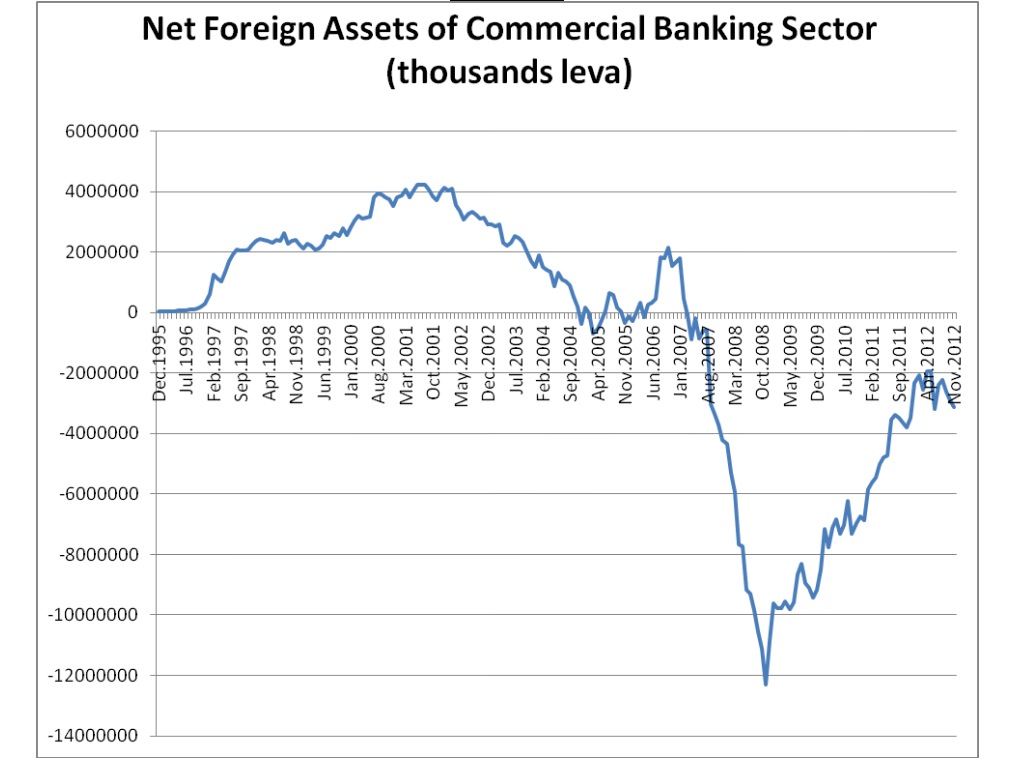
The latter can be confirmed by the dynamics of the Net Foreign Assets (NFA) of the commercial banking sector- the positive sign of NFA reflects surplus foreign investment position of the banking sector and vice versa; correspondingly an increase of NFA indicates capital outflow and decrease of NFA- capital inflow.
As we can see from the Graph №1, under the period 1995-2001, the NFA raises what reflects the process of leaking of bank funds from the country. From 2002 to 2008 capital inflow prevails and starting with 2006 the NFA became negative. This reveals the fact that the banking system has become an important instrument of net external borrowing.
The Graph №1 tells us also that until 2006 the repatriation of previously transferred abroad domestic capital prevails. From 2006 till 2008 we observe swift foreign capital influx. This is the period of the final push of the global financial bubble. From 2008 up to the end of 2011 we see equally hasty bank funds outflow. In 2012 and later the situation is unstable.
Graph №1
Source: Bulgarian National Bank
The dynamics described above reflect the extremely high volatility of capital movements between Bulgaria and international financial markets. The precariousness of financial flows is a result of the lack of confidence in the fundamentals of Bulgarian economy and high risk perception. In the same time, the swift re-switching of capital flows from an increase to decrease of the NFA in the 2006-2011 period substantiates the total lack of control on the part of monetary authorities over the capital movements under the currency board rule type of monetary regime introduced in Bulgaria in 1997[1].
The European membership of Bulgaria additionally strengthened the capital inflow in the period 2007-2008. The external capital influx was correlated with private investment acceleration and boom in construction sector. In structural terms however the Bulgarian economy was unable to overcome its dependence on economic sectors with low value added (Mitra and Pouvelle, 2012) and to create sustainable employment in the sphere of manufacturing industry and agriculture. Only the tourism and the financial sector firmly increased their share in GDP.
The reaction of the macroeconomic policy to the challenges of the global financial bubble was limited to the solutions suggested by the so called twin deficit hypothesis (Ganchev, 2010). The main idea was to generate fiscal surpluses in order to limit the current account deficits that reached more than 25% of GDP in 2007. The objective to attain external equilibrium was not met, but fiscal austerity allowed the country to accumulate financial reserves. The latter turned out to be very helpful in the period of economic crisis.
The Global Financial Crisis Impact
In the first months of the global financial crisis in 2008 the physiological climate in Bulgaria was characterized by the lack of understanding about the depth and severity of the coming economic troubles. The need for active countercyclical economic policy measures on the part of government and the central bank was underestimated. Both business and political circles shared the opinion that no bold actions should be taken. This passive strategy was exactly the opposite of what should have been done in the situation of rapidly worsening economic conditions.
In addition to this in the beginning of the crisis period Bulgaria committed a strategic error rejecting the suggestion of the IMF to use Flexible Credit Line facility just introduced by the international financial institution in order to help countries members with sound macroeconomic indicators to prevent the negative consequence of spreading financial contagion. The initiative of the IMF was a part of the new strategy of preemptive anti crisis actions implemented for the first time in history of the Fund. Bulgaria made a choice exactly the opposite of that of Poland which signed an agreement with the IMF in 2009. Poland was the only country in EU that did not register an economic decline under the crisis demonstrating exceptional economic resilience (IMF, 2012).
Later the new government, formed after the parliamentary elections in 2009, assumed the odd strategy of conveying all external and internal shocks straight to the private sector. The government was not ready to accept any further temporary increase of state debt in order to support the economy suffering from the decline of domestic and external demand. On the contrary, the authorities postponed payments due to the private sector thus activating the process of bed debt and inter-firm indebtedness accumulation. This attitude of the state seriously hindered the private sector adjustment efforts.
The year 2009 marks a radical shift of macroeconomic trends. The capital inflow induced by the global savings glut was replaced by intensive capital flight. The leaking of funds was especially intensive in the banking sector as already discussed. Foreign direct investments declined as well. The quotations on the Bulgarian Stock Exchange shrunk and the capital marked remains erratic and undervalued for the whole post-crisis period.
The shortage of capital and the growing uncertainty caused a rise of interest rates on bank credits and deposits. The volume of lending declined, fixed capital investment fell dramatically. Public and private consumption also decreased, exports, especially in 2009, dropped and remained unstable. All this was inevitably interrelated with shrinking of GDP and rise of unemployment. The decline of Bulgarian economy in 2009 was not compensated in the period 2010-2012 and the recovery prospects are not optimistic (EC, 2013).
The foreign trade sector also experienced radical shifts. The trend of ever increasing current account deficits was replaced by a relatively balanced exchange of goods and services. This is a consequence of constrained domestic consumption and investment. In the same time, in complete disagreement with the twin deficit hypothesis, the fiscal sector began to generate structural deficits in spite of surpluses. One of the reasons for this development was the distorted structure of government revenue, relaying too much on taxing consumption rather than income. The explanation of this is based on the classical thrift paradox. People decreased consumption and increased savings. As a consequence a bigger share of the income was not taxed. To avoid high deficits government cut spending and closed the negative feedback.
The transformation of the state into negative shock accelerator led to further economic climate deterioration. The corporate sector and the households responded by additional cut of investment and consumption thus creating more savings. However, the banking sector was not ready to transform rising deposits into new lending to business since the level of bed debts was already too high. This situation straightforwardly led to further capital outflow. The government also contributed to domestic financial system stagnation by placing in 2012 the new debt issue with consortium of foreign banks rather than on national market.
The basic concept of the government macroeconomic policy also underwent changes. The twin deficit hypothesis was replaced by an extreme variant of right-wing neoliberal economic policy. It was assumed that putting a legislative limit to state redistribution, imposing a low level of budget deficit and applying low flat income tax would guarantee fast recovery. Though the implementation of these ideas could have some anti cyclical effect in the long perspective (Andritzky, 2011) they do not guarantee recovery in the short run. On the other hand, limiting by low the share of government spending contradicts the constitution of the country proclaiming that Bulgaria is a social state, i.e. a state that is supposed to finance all socially desirable activities.
In particular, it was supposed that institutionalized fiscal austerity as well as low income and corporate taxation would improve the country credit rating, attract foreign direct investment and restore growth. The monetary policy was based on similar principles. If we exclude the short-lived attempt to apply a more active monetary policy via lessening commercial banks minimum reserve requirements, the central bank confines its activities to enforcing financial risk supervision.
The Consequences of the New Policy
The economic policy devotion to the neoliberal principles did not produce the expected results. The fiscal austerity really allowed for some improvement of the official credit rating of Bulgaria, but the expected foreign capital inflow did not take place. On the contrary, the stabilization of the financial parameters of the state turns out to be correlated with the worsening of the financial situation of the private sector- the foreign indebtedness of the corporate sector, the share of bed debts in the portfolio of commercial banks and the inter corporate debt level increased. It is true that the share of government debt of Bulgaria in the GDP is one of the lowest in the group of the Eastern European countries but the net foreign investment position is among the worst. From this point of view the situation of the country is similar to that of Ireland before the crisis.
The mechanical connection between the current government spending and current receipts transforms the fiscal sector into powerful accelerator of all negative shocks to the national economy. The fiscal hardship, the complete lack of ability of central bank to keep interest rates down combined with the fixed exchange rate regime created together a unique climate of rigidity that led to slow and painful economic recovery.
Paradoxically enough the low level of government indebtedness did not exclude fiscal liquidity risks. The reason is that fiscal deficits, even if relatively insignificant, were financed not via additional borrowing but at the expense of diminishing of fiscal reserves. Since these reserves were kept in the central bank and were part of the official foreign exchange reserves of the currency board, the coverage of the domestic monetary emission declined and the stability of the monetary system was under threat. The restoration of the soundness of the public finance seems a difficult task.
We should admit also that neoliberal strategy in Bulgaria strangely includes elements of Keynesian policy especially in the field of infrastructure building. These elements become possible because of the EU structural funds but remain subordinated to fiscal severity and do not change the overall economic dynamics. Nevertheless we should mention that according to some estimates up to 60% of the slow economic growth after 2009 can be explained by the EU structural funds utilization.
If we assume that the objectives of the economic policy are not the financial parameters as such but indicators reflecting real incomes, employment, risk of poverty and so on, then the results of Bulgarian are the worst in the EU. For example, according to the last data published by the EC, 49,1 % of total population of Bulgaria is at risk of poverty and social exclusion, a result second to none in the EU. If we compare Bulgaria to Greece, country given as an example of disastrous macroeconomic policy, the same indicator is only 31% (Eurostat, 2013).
In broader terms the macroeconomic policy should not aim only at attaining full employment and high real incomes while securing financial stability, but should also guarantee the steady reproduction of national economy, including at first place the workforce.
The low birth rates and the continuous decline of the population demonstrate that the macroeconomic policy is not attaining this most fundamental objective. We observe also very close connection between the birth rate and the people’s perception of the prevailing economic conditions. In particular, the economic crisis has so strong impact on the population, that the birth rate in 2012 is as low as in 1997, the year of the previous economic downturn, combined with brief hyperinflation episode. The young people still do not see other perspective but to leave the country. At the end of 2012 for the first time in the history of Bulgaria the number of working people matched the number of retired population. In terms of social equity, Bulgaria is not only the poorest country in the EU, but also the country with one of the highest levels of income disparity.
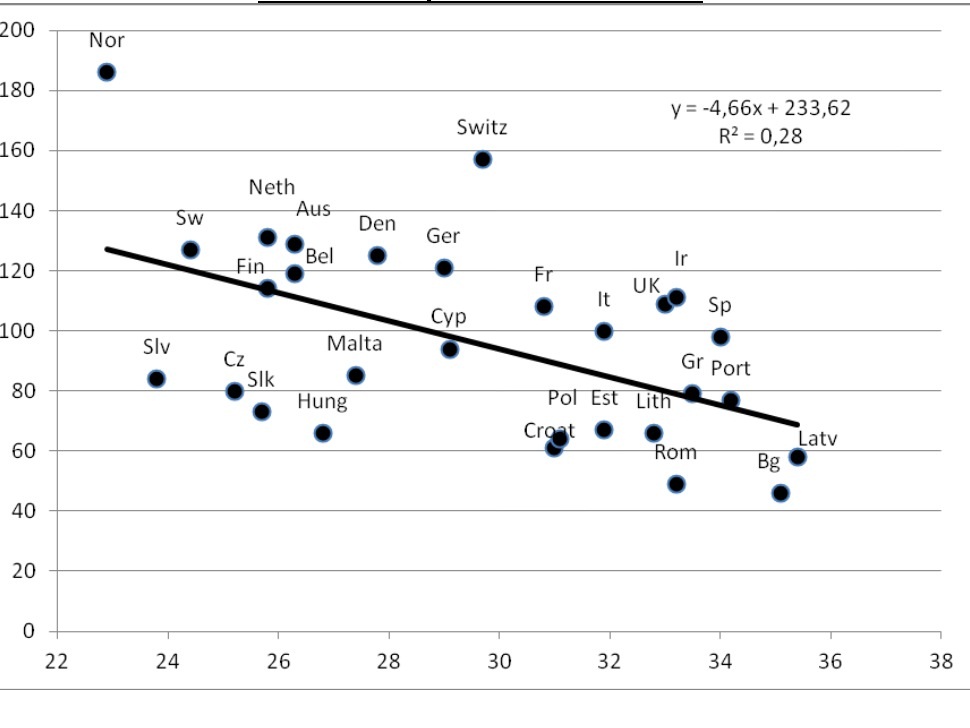
The relationship between the comparative income level and income inequality is illustrated at Graph №2. The per capita income level of selected countries is plotted at the vertical axis as a percentage of EU27 average and the income disparity is measured in terms of respective GINI coefficients, mapped at the horizontal line. As we can see from the graph, the income inequality and per capita income levels are negatively linked, Bulgaria being the poorest country with income disparity second only to that of Latvia.
Graph №2
Comparative Per Capita Income Levels (EU 27=100%) and GINI Coefficients of Selected European Countries in 2011
Source: Eurostat
Given these negative parameters, it is not surprising that the extremely high electricity bills in the beginning of 2013 sparked popular discontent against the government economic policy and the political elite as whole. This led to retirement of the government and preliminary elections that took place at 12th of May 2013. These elections however did not produce up to now any clear alternative of the previous rule.
Can We Sketch Some Conclusions?
In terms of macroeconomic policy, Bulgaria, according to some IMF research, can still rely on positive fiscal multipliers (Muir and Weber, 2013), so a stimulating macroeconomic policy is possible. The relatively low level of government debt is also a positive circumstance.
However, the legislation, adopted by the previous government, limits the level of state spending to 40% of GDP and imposes a cutoff point of budget deficit to 2% of GDP. This makes any modification of the current macroeconomic policy virtually impossible without legislative amendments. In the long run the 40% limit makes unfeasible any sustainable improvement in the field of education, health care, infrastructure, research and development, pension system and so on. The normalization of the public services supply requires the government spending to be near the average EU level what means an increase of up to 10 percentage points. Such an upsurge implies higher taxation rates and is politically unacceptable.
A possible solution to the problem could be the use of EU structural funds and more intensive EU integration. This is the policy, suggested by many political parties in Bulgaria. Yet Bulgarian politicians do not take into account that the new long term European financial framework program assumes for the first time reduction of the available resources. In addition, the use of funds will be subject to additional conditionality and competitive constraints.
On the other hand, the attitude of Bulgaria to the EU integration furthering was discontinuous. In particular, up to 2010, the main objective of the country was the accession to the Eurozone. However the country failed to attain this objective due to its inability to meet the Maastricht criteria. Bulgaria did not share the policy of high fiscal deficits adopted by EU in the beginning of the crisis in order to support domestic demand and to recapitalize the banking sector.
Later the EU public debt crisis changed the strategic orientation of the country. The Eurozone accession was abandoned as immediate objective. The government was skeptical about the European Financial Stabilization Mechanism and was reluctant to support the idea of financial solidarity. The previous administration essentially rejected the fiscal union as the latter would lead to higher taxation. The bank union is accepted without enthusiasm. Bulgaria supports only the fiscal austerity measures, not taking into account that in Eurozone such measures are smoothed by the accommodative monetary policy implemented by the ECB, especially after 2012. There is a real danger that Bulgaria could be expulsed from the core to the periphery of the European economic and political integration.
In structural terms the economic crisis revealed the lack of competitiveness of the Bulgarian economy, its dependence on cyclically sensitive economic sectors. The strategy of reliance on foreign direct investment is also under reconsideration. In sectors, such as electricity generation, electricity supply, liquid fuels, finance, retail trade and others, we observe the emergence of monopolistic structures, controlled by foreign entities. In some cases, namely electricity supply and production, foreign companies are in fact subsidized by the state with guaranteed high profits. In the same time the corporate taxation is extremely low.
Bulgaria is an example, that foreign capital inflow is not automatically beneficial for the domestic economy. We should never forget that from theoretical point of view the net foreign capital inflow in the long run is zero. This follows from the fact that the investment equals the discounted sum of future profits presumably transferred abroad. Strategically the country benefits from technology transfer and access to global networks. Under some circumstances external control over highly monopolized sectors may have negative effect as in the case of electricity industry in Bulgaria. This implies the need of selective policy in field of foreign investment.
The market imperfections have especially negative impact on the small and medium size enterprises. They suffer particularly from the high energy prices and expensive bank lending. Retail chains may also obstruct the access of small business to markets. All this also requires special government support.
The agriculture was the only sector that really benefited recently from the EU integration. But here also we observe excessive concentration of funds in specific sectors and privileged position of big farmers.
To resume, we can conclude that virtually all economic and social problems of Bulgaria reduce to two sources- incompetent and corrupted governments and naïve belief that unregulated markets, low taxation, fiscal austerity and monetary neutrality automatically resolve all puzzles. Overcoming these obstacles would require however strong and focused efforts.
Bibliography
Andritzky J. R., (2011). Evaluating Designs for a Fiscal Rule in Bulgaria, IMF, WP/11/272
EC, (2013). European Economic Forecast, Winter 2013, European Economy, 1/2013
Eurostat (2013), Newsrelease, 28/2013 – 26 February 2013
Ganchev G. T., (2010). The Twin Deficit Hypothesis: The case of Bulgaria. Financial Theory and Practice 34 (4), pp 357-377
IMF, (2012). Republic of Poland—Review Under the Flexible Credit Line Arrangement—Staff Report and Statement by the Executive Director. IMF Country Report No. 12/12
Mitra P. and Pouvelle C. (2012). Productivity Growth and Structural Reform in Bulgaria: Restarting the Convergence Engine, IMF, WP/12/131
Muir D. and Weber A., (2013). Fiscal Multipliers in Bulgaria: Low But Still Relevant, IMF, WP/13/49
[1] The currency board rule is a monetary system based not on the central bank implemented monetary policy, but on the idea of self adjustment of financial and other markets. Under the Bulgarian variant of currency board the money issued by the central bank is limited by the amount of the foreign currency reserves. The exchange rate is fixed against the euro, the central bank is not allowed to refinance commercial banks, except in the case of systemic crisis, all types of open market operations with domestic securities and national currency are also forbidden. The central bank does not have any control over the interest rates. The economy is supposed to self adjust on the basis of a kind of price-specie-flow mechanism. In other words it is a gold standard type of monetary system, but the gold is replaced by foreign currency. In the case of Bulgaria, the fiscal sector has some influence on monetary base since the fiscal reserve is part of the liabilities of the currency board. Under such a system the central bank does not dispose with operational instruments to affect capital movements.